



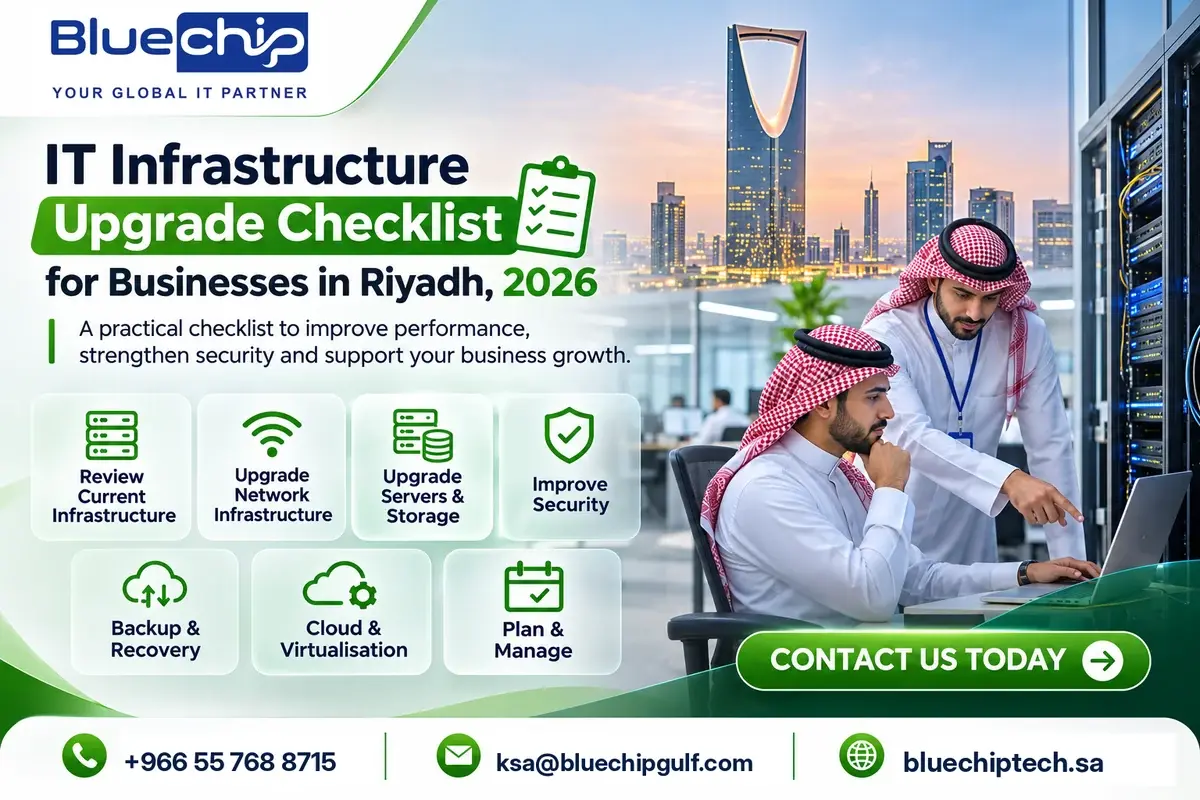
IT Infrastructure Upgrade Checklist for Businesses in Riyadh, 2026
With businesses in Riyadh becoming increasingly reliant on cloud services, digital apps and other connected technologies, having up-to-date IT infrastructure is essential. If your business has outdated servers, slow network speeds, low storage and poor security measures in place this will impact productivity.
By upgrading your IT infrastructure can help increase performance, improve security and allow your organisation to grow. Here is our checklist to help you understand what areas you should consider upgrading.
1. Review Current Infrastructure
Before investing in new infrastructure, take a look at your current set-up. This includes examining your servers, network speed, storage, age of hardware, software compatibility and ongoing issues.
This will give you an idea of what areas you need to focus on immediately and what areas you can improve.
Working with an IT Infrastructure Solutions company with experience can help identify any current limitations, risks and create an upgrade that works for your business.
2. Upgrade Network Infrastructure
Having a good connection is essential when it comes to communication, using cloud services, file sharing and working with different departments. If your network isn’t up-to-date it may cause issues as your workforce grows and more devices are connected.
Look at your switches, routers, wireless access points, bandwidth and network security.If applicable, consider upgrading to a segmented network.
Also look at your cabling and ensure your network can cope with any future growth.
3. Upgrade Servers and Storage
If your servers are old and you don’t have enough storage this can cause slower performance in business apps. You need to ensure you are using servers with enough processing power and storage capacity.
Depending on your needs you could upgrade your servers, optimise storage or use virtualisation. If your business has varying workloads you may want to look into cloud infrastructure.
It will depend on your applications, security, budget and business goals.
4. Improve Security
When upgrading your infrastructure it is important to look at your current security. If your software is outdated, users have too many permissions, software isn’t updated and your network isn’t properly secured this can cause issues.
Ensure your firewalls, endpoint protection software, permissions, software updates and security monitoring are all in place. Also consider implementing multi-factor authentication and keeping sensitive data secure.
Working with an IT Solutions Services company with experience in KSA can help identify areas of your current set-up and help you improve your infrastructure security.
5. Backup and Recovery
If your hardware fails unexpectedly, there is a cyber issue or data has been accidentally deleted it can cause issues. Having good backup and recovery in place will help prepare for this.
Ensure you are regularly backing up any critical data. Test your recovery processes and ensure you have Recovery Time Objectives (RTO) and Recovery Point Objectives (RPO).
Consider using secure offsite or cloud storage, limiting access and having processes in place.
6. Look Into Cloud and Virtualisation
Cloud services and virtualisation can help improve flexibility.
Before moving your workloads consider your applications, data security, cost, connection and management. You don’t have to move everything to the cloud, some businesses may benefit from a hybrid setup.
By carrying out a thorough assessment it will help ensure your technology is helping your business.
7. Plan and Manage
To ensure your upgrade is a success you will need to create a realistic plan. This includes a timeline, budget, testing and migration.
Try to avoid any disruptions during busy times and test your applications, network connectivity, user access and back-ups.
Plan regular maintenance, software updates, monitoring and technical support.
Create a Future Ready IT Environment with Bluechip
By carefully upgrading your infrastructure you can help improve your businesses efficiency, security and help your business grow sustainably. Any improvements you make to your network, servers, cloud services and recovery should be to meet a specific business need.
Bluechip Advanced Technologies provides IT infrastructure and technology solutions to suit your businesses needs throughout Saudi Arabia. We provide infrastructure solutions, storage, virtualisation, disaster recovery, cloud migration and network security.
Whether you’re looking to upgrade your current office or get your business ready for growth choosing the right IT Infrastructure Solutions company can help.
Ready to upgrade your IT infrastructure in Riyadh? Get in touch with Bluechip Advanced Technologies.
FAQ
How do I know when my IT infrastructure needs an upgrade?
Look for repeated hardware failures, unsupported systems, capacity constraints, slow applications, network bottlenecks, poor backup performance, security gaps, limited monitoring, difficulty scaling, and growing maintenance effort. Business changes such as opening new locations, adopting cloud applications, increasing data volumes, or introducing new security requirements can also trigger an upgrade. Decisions should be supported by asset lifecycle, performance, risk, and capacity data.
What should be included in an IT infrastructure assessment?
The assessment should inventory servers, storage, networks, wireless, firewalls, endpoints, virtualization, cloud services, backup, power and rack infrastructure, monitoring, software dependencies, warranties, support status, capacity, performance, and security configuration. It should identify single points of failure and business-critical dependencies, then prioritize recommendations by risk, business impact, cost, and implementation complexity.
Which IT infrastructure components should businesses assess first?
Begin with components that support critical services or create the greatest operational and security risk. This commonly includes internet connectivity, core switching, firewalls, identity systems, servers and storage, backup and recovery, power protection, virtualization, and monitoring. The correct order depends on the environment; a dependency map helps prevent an upgrade to one component from exposing an overlooked bottleneck elsewhere.
How can a Riyadh business upgrade IT infrastructure with minimal downtime?
Plan the upgrade around dependencies and business-critical periods. Back up configurations and data, test new infrastructure, stage equipment before cutover, use redundancy where justified, migrate in controlled phases, and maintain a documented rollback path. Assign technical owners and acceptance tests to each stage. After cutover, monitor performance, security events, backups, and user-impacting services before closing the change.


