




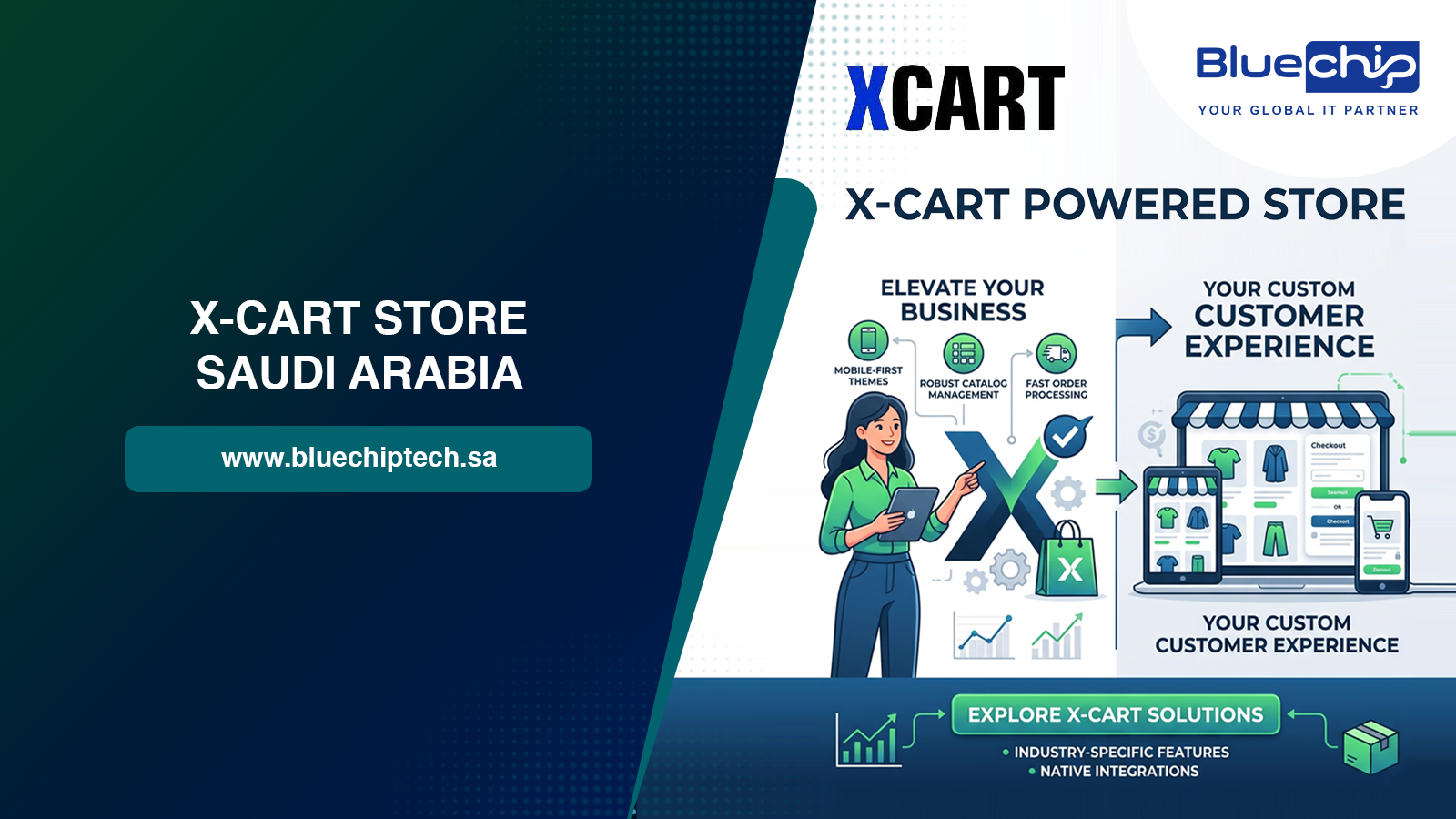
X-Cart Development for Business-Focused eCommerce
X-Cart is an eCommerce platform that can support configurable storefronts, product catalogs, checkout, payments, integrations and custom development. For businesses evaluating X-Cart in Riyadh, the important question is not simply whether the platform has enough features. The store also needs to fit the way products are managed, orders are processed, customers pay, deliveries are handled and internal systems exchange data.
Bluechip Advanced Technologies can support X-Cart projects from requirement planning through implementation, customization, migration and ongoing technical improvements. The scope should be defined around the business model, catalog complexity, languages, payment and shipping requirements, integrations, expected traffic and the level of custom development needed.
What X-Cart Development Can Cover
- Platform and requirement assessment — review whether X-Cart suits the catalog, sales model, operational workflow and integration needs.
- Store setup and configuration — structure core store settings, catalog logic, customer flows and administrative requirements.
- Storefront customization — adapt layout, navigation, product presentation and brand components without compromising usability.
- Catalog architecture — plan categories, attributes, variants, product data and bulk-management requirements before migration or launch.
- Checkout and payment planning — configure supported payment options and validate the required customer journey before go-live.
- Shipping and fulfilment integration — connect shipping or logistics workflows where suitable integrations are available.
- API and third-party integrations — plan connections with ERP, CRM, inventory, analytics or other business systems using supported APIs or integration methods.
- Migration — map products, customers, orders, URLs and other essential data when moving from an existing eCommerce platform.
- Arabic and multilingual planning — evaluate language, translation and right-to-left storefront requirements for the intended audience.
- Mobile storefront review — test key shopping journeys on common mobile screen sizes and reduce avoidable checkout friction.
- Search and discoverability — organize store structure, metadata and crawlable content so the platform can support broader SEO work.
- Security-aware implementation — keep platform, extensions, access permissions, backups and payment architecture within an appropriate maintenance process.
- Testing and launch — validate catalog, forms, checkout, transactional messages, integrations and critical user journeys before release.
- Ongoing improvements — review updates, feature requests, integration changes and operational issues after launch.
Practical Advantages of a Well-Planned X-Cart Store
Flexible storefront and customization
X-Cart supports configurable storefronts and API-driven customization, which can be useful when a standard template does not fully match the business process.
Catalog and commerce operations
Product, order, inventory and sales-channel workflows can be organized around the way the business sells and fulfils orders.
International and multilingual options
X-Cart documents support for multiple languages and currencies, including Arabic language support. Actual localization scope should be defined during implementation.
Integration potential
Supported APIs and apps can connect the store with payment, shipping, marketing and back-office systems; each required integration should be confirmed before commitment.
Discuss Your X-Cart Requirements
If you are planning a new X-Cart store, migrating an existing eCommerce site or improving a current X-Cart implementation, start with the operational requirements rather than a feature checklist. Bluechip Advanced Technologies can review the project scope, integration needs, storefront requirements and technical constraints before implementation decisions are made.
Planning an X-Cart Store, Migration or Upgrade?
X-Cart Services We Can Support
An X-Cart project may involve more than installing a storefront. The technical scope should be selected according to the business model and existing systems.
- New X-Cart store setup and configuration
- Storefront and theme customization
- Catalog, category and product-data structuring
- Checkout and customer-flow customization
- Payment and shipping integration planning
- ERP, CRM, inventory and third-party API integrations
- Migration from another eCommerce platform
- Arabic / multilingual storefront planning
- Testing, launch assistance and post-launch improvements
How We Approach an X-Cart Project
- Define the business model and project goals. Clarify what is sold, who buys, where orders are fulfilled and which systems must connect to the store.
- Map catalog, storefront and integrations. Document products, variants, customer flows, languages, payment, shipping and back-office requirements.
- Configure and customize. Build the approved store structure and implement only the integrations and custom functions that have been validated.
- Migrate and test. Move required data, test customer journeys, check transactional functions and validate critical integrations.
- Launch and monitor. Release the store using an agreed launch plan, then review technical issues and prioritized improvements.
Planning X-Cart for a Saudi Business
For a Saudi-facing store, platform selection should be tested against the actual commercial and regulatory workflow rather than assumed from a feature list.
- Arabic and English content requirements, including right-to-left storefront testing
- Saudi Riyal pricing and any multi-currency requirements
- Payment gateways required by the business and whether suitable X-Cart integration methods exist
- Shipping and last-mile providers used by the operation
- VAT and invoicing workflow, including any ZATCA-related system requirement that may need a separate integration or accounting process
- Customer data, privacy and access-control requirements
- ERP, inventory, CRM, warehouse or marketplace connections
- Hosting, backup, update and maintenance ownership
Migrating an Existing Store to X-Cart
A successful migration is primarily a data and process project. Before moving, identify which data must be retained and how it will map into the new store.
- Products, categories, variants and attributes
- Customer accounts and available historical data
- Orders and order status history
- Images, downloadable files and product documents
- URLs, metadata and redirect requirements
- Coupons, pricing rules and customer groups
- Payment, shipping and back-office integrations
- Transactional emails and operational notifications
Migration scope should be confirmed after reviewing the source platform, data quality and integration dependencies.
When Should a Business Consider X-Cart?
X-Cart may be worth evaluating when a business needs a configurable eCommerce platform, expects meaningful catalog or integration work, and wants the ability to customize beyond a basic hosted storefront.
It should not be selected simply because a long feature list sounds impressive. Compare the required catalog complexity, internal technical resources, integration needs, maintenance model and total operating cost with alternatives such as WooCommerce, Magento or PrestaShop before committing.
Why Work With Bluechip Advanced Technologies on an X-Cart Project?
X-Cart may be worth evaluating when a business needs a configurable eCommerce platform, expects meaningful catalog or integration work, and wants the ability to customize beyond a basic hosted storefront.
It should not be selected simply because a long feature list sounds impressive. Compare the required catalog complexity, internal technical resources, integration needs, maintenance model and total operating cost with alternatives such as WooCommerce, Magento or PrestaShop before committing.
FAQ
What is X-Cart?
X-Cart is an eCommerce platform for building and operating online stores. Current X-Cart offerings include configurable commerce functionality, integrations, APIs, storefront customization and tools for managing products and orders. The right fit depends on the store’s catalog, operational model and integration requirements.
What is included in X-Cart development services?
A project can include requirement analysis, store configuration, storefront customization, catalog setup, data migration, payment and shipping setup, third-party integrations, testing, launch support and post-launch improvements. The exact scope should be confirmed before implementation.
Can X-Cart support Arabic storefronts?
X-Cart documents multilingual capabilities and includes Arabic among the languages it can support. A Saudi project should still test right-to-left layouts, translated content, fonts, checkout text and any third-party extension interfaces before launch.
Can an existing eCommerce store be migrated to X-Cart?
Yes, migration can be planned, but the data map matters. Products, variants, customers, orders, images, categories, URLs, redirects and integration dependencies should be reviewed before deciding the migration method.
Can X-Cart integrate with payment, shipping or ERP systems?
X-Cart provides integrations and APIs, but support varies by system and project. Each required payment gateway, shipping provider, ERP, CRM or inventory connection should be verified before the implementation scope is finalized.
How is X-Cart different from WooCommerce or Magento?
They use different architectures, ecosystems and operating models. The better choice depends on catalog complexity, customization requirements, internal technical resources, integration needs, budget and long-term maintenance expectations. The page should not claim one platform is universally better.
What should a Saudi business check before choosing X-Cart?
Review Arabic/English requirements, payment and shipping options, catalog size, inventory workflows, tax and invoicing requirements, integration needs, internal administration, maintenance ownership and migration complexity. Native support for any Saudi-specific service should be verified rather than assumed.
Does Bluechip Advanced Technologies guarantee a specific X-Cart result or compliance outcome?
No fixed result should be promised without evidence. Store performance, conversion, security and compliance depend on the platform configuration, hosting, integrations, data quality, content, business process and ongoing maintenance. Any regulatory or payment-compliance requirement should be validated for the final implementation.


