



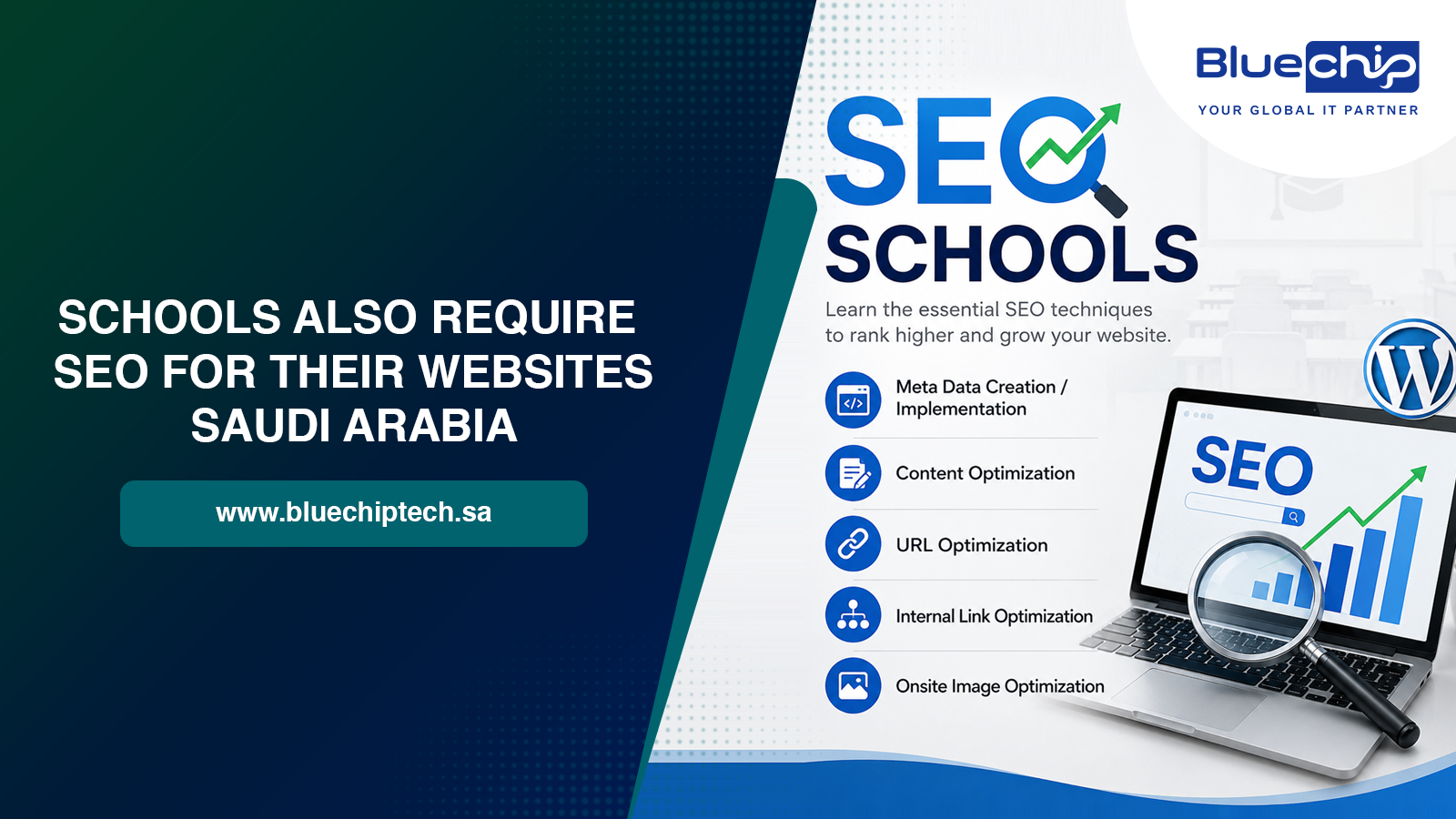
Parents rarely begin their school search with a single brand in mind. They compare locations, curricula, academic stages, admissions information and practical details before deciding which schools deserve closer attention. For schools in Saudi Arabia, that makes organic search visibility part of the admissions journey rather than simply a source of website traffic.
Bluechip Advanced Technologies provides SEO for schools in Saudi Arabia with a focus on helping important curriculum, campus and admissions pages become easier to discover and easier for parents to use. For schools targeting families in Riyadh, the strategy can combine technical SEO, Arabic and English search planning, local visibility and stronger conversion paths. The objective is relevant visibility: helping prospective families find accurate information and move naturally from research to enquiry.
SEO Built Around How Parents Search for Schools in Saudi Arabia
A parent researching schools may begin with a broad location or school-type query and become more specific as the shortlist develops. Later searches can focus on curriculum, grade level, campus location, admissions procedures, contact details or other information published by the school. The website therefore needs to support multiple stages of research without forcing every visitor through the same page.
This matters in Riyadh, where location can be an important part of the decision process. A school may have strong educational information but still lose visibility if its campus pages are thin, its admissions content is difficult to reach, or search engines cannot clearly understand how curriculum, academic-stage and location pages relate to one another.
An effective school SEO strategy maps these different intents to appropriate pages. It also distinguishes Arabic and English searches instead of assuming that parents use identical terminology in both languages. The goal is not to attract the largest possible audience; it is to connect the school with families whose searches match what the institution genuinely offers.
Turning Search Visibility Into Admissions Enquiries
Ranking a page is only part of the journey. Once a parent arrives, the page needs to answer the question that triggered the search and make the next step obvious. A curriculum page, for example, should not hide admissions information behind several menus. A campus page should help a family understand the location and find the relevant contact or enquiry route.
Useful conversion paths can include an admissions enquiry, a request for information, a campus-visit enquiry, application guidance, or clear telephone and contact options. The right action depends on the school’s actual admissions process.
SEO and conversion usability therefore need to work together. If organic visitors repeatedly reach a page but cannot find the next relevant step, increased traffic alone has limited value. School SEO services in Saudi Arabia should be measured against meaningful visibility and enquiry actions, not page views in isolation.
Curriculum and Academic-Stage SEO
Curriculum and academic-stage pages often sit close to the centre of a parent’s decision. These pages should be built around real offerings and provide enough substance to answer common research questions. They should not exist simply because a keyword can be placed in a title.
For each genuine curriculum, academic stage, learning pathway or program, optimization can consider search intent, a clear page title and H1, descriptive headings, useful parent-facing information, contextual internal links and a relevant admissions route. If the school publishes student-support or activity information, those pages should also connect logically to the academic content they support.
Clear differentiation matters. When several pages target almost the same topic with only minor wording changes, search engines may struggle to identify which page is most relevant. Consolidating overlapping content or giving each page a distinct purpose can create a cleaner experience for both parents and crawlers.
Arabic and English SEO for Saudi Schools
Bilingual school SEO is more than translating an English page and publishing the same wording in Arabic. Parents searching in Arabic may use different terminology, phrasing and levels of specificity. Separate keyword and search-intent research helps determine how each language version should be structured while keeping institutional information consistent.
A sound bilingual setup can include separate language URLs, accurate hreflang implementation, appropriate canonical tags, language-specific titles and descriptions, and internal links that allow users to move between equivalent pages. Arabic pages also need usable right-to-left layouts, navigation and forms rather than a technically translated page that is awkward to use.
Content quality should be comparable across both languages. Important admissions or curriculum information should not be complete in English but reduced to a few lines in Arabic, or vice versa, without a genuine editorial reason. Human review is also important for educational terminology and parent-facing copy. Automated translation can support workflows, but publishing an entire school site without linguistic and factual review can introduce errors that affect trust as well as search relevance.
Looking for the Right IT Solution for Your Business?
Local SEO for Schools in Riyadh
For a physical school campus, local visibility is closely connected to how accurately the institution presents its location online. Parents may search for schools in Riyadh, within a particular area, or near places relevant to their daily routine. A genuine campus page should therefore provide useful location information rather than functioning as a thin city-keyword page.
Local optimization may include an accurate Google Business Profile where applicable, consistent school name, address and phone details, correct map information, clear campus directions and relevant contact information. Reviews and reputation signals can also influence how families evaluate a school, although review activity should be handled according to the school’s own policies and platform guidelines.
For school groups with more than one real campus, each location can have a distinct page containing information specific to that campus. Creating dozens of near-identical neighbourhood pages solely to target keywords is a different approach and can leave parents with little useful information.
Technical SEO for School Websites
School websites often grow over time as admissions updates, news, events, policies, curriculum pages and campaign landing pages are added. Without technical controls, outdated or duplicate URLs can remain indexable while important pages become buried.
A technical review should examine XML sitemaps, robots.txt, meta robots directives, canonical tags, redirects, broken URLs, duplicate pages and orphan content. Accidental noindex directives can prevent a key admissions page from appearing in search, while an incorrect canonical can point consolidation signals toward the wrong URL. Redirect chains and broken internal links can also make frequently updated school content harder to crawl and navigate.
Architecture matters just as much. A logical relationship such as School > Campus > Curriculum or Academic Stage > Admissions > Enquiry gives users and search engines clearer pathways. Breadcrumbs, contextual links and concise navigation help reduce crawl depth and prevent valuable pages from becoming isolated.
Mobile Experience and Core Web Vitals
Parents may research schools on mobile devices while comparing several options, checking directions or returning to admissions information. Performance problems can interrupt that process.
Largest Contentful Paint (LCP) can be affected by oversized campus imagery, slow server response, heavy templates or render-blocking resources. Interaction to Next Paint (INP) can suffer when navigation, forms or other interactions depend on excessive JavaScript and third-party scripts. Cumulative Layout Shift (CLS) measures unexpected movement and can be affected by images without dimensions, late-loading fonts, banners and dynamically inserted elements.
Practical improvements can include image compression and appropriate formats, caching, script and font optimization, template improvements, CDN considerations where suitable, server review and real mobile testing. Core Web Vitals support usability and technical quality, but passing them does not by itself guarantee higher rankings.
On-Page SEO for Admissions, Curriculum and Campus Pages
Each priority page should have a defined search purpose. Titles, meta descriptions, headings, URLs and body content should reflect that purpose naturally. Image alt attributes, breadcrumbs and internal links can provide additional context, while location relevance should appear where it genuinely helps a user.
Admissions pages should focus on admissions intent. Curriculum pages should explain the relevant academic offering. Campus pages should answer location and campus-specific questions. Separating these purposes reduces unnecessary overlap and gives search engines a clearer set of pages to evaluate.
Calls to action should also match the page. A parent reading admissions guidance may need an application or enquiry route, while a campus page may be better served by contact details or a visit-related action.
Structured Data for School Websites
Structured data can help search engines interpret entities and page relationships when it accurately matches visible content. Depending on the site and page, relevant types can include Organization, EducationalOrganization, School, BreadcrumbList, Event for genuine events, and Article or NewsArticle for suitable editorial content. LocalBusiness should only be used where it accurately represents the entity and context.
Schema should be validated after implementation and reviewed for duplication or conflicts, especially when a CMS, theme and SEO plugin can each output markup. Structured data can improve machine-readable context, but it does not guarantee rich results or rankings.
Building Trust and Authority Through Useful School Content
Technical fixes cannot replace accurate, useful information. Parents need confidence that the content they find reflects the school itself. Admissions guidance, curriculum explanations, campus information, policies, parent FAQs, educational resources, events and leadership information can all support that need when they are current and genuinely relevant.
Accuracy is particularly important for fees, admissions requirements, curricula, accreditations, facilities and policies. These details should come from official school information and be updated when circumstances change. Search visibility built around outdated information may attract clicks while damaging the user experience that follows.
Measuring School SEO Performance
Total traffic is a weak KPI when viewed alone. A stronger measurement framework can include visibility for priority searches, curriculum and campus page performance, admissions-page organic traffic, Search Console impressions and clicks, indexation of priority pages, Arabic-versus-English performance, Core Web Vitals, local visibility where measurable, and relevant enquiry actions.
The KPI set should reflect the school’s actual admissions and visibility objectives. That makes reporting more useful to marketing and admissions teams and helps identify whether SEO improvements are reaching the right audience.
Our School SEO Process
A practical engagement can move through the following stages:
- School website and search-visibility review
- Technical SEO audit
- Parent search-intent research
- Saudi and Riyadh keyword research
- Arabic and English planning where required
- Campus, curriculum and admissions architecture review
- Technical fixes and on-page optimization
- Local SEO and structured-data review
- Internal linking and conversion-path improvements
- Performance monitoring and continuous refinement
The priorities should be based on the site’s actual condition rather than applying the same checklist to every school.
Why Work With Bluechip Advanced Technologies?
Bluechip Advanced Technologies approaches school SEO as a combination of technical quality, search-intent planning, content structure and local relevance. For Saudi schools, that means considering how parents search, how Arabic and English content is organized, how campus and admissions pages connect, and whether technical issues are limiting discovery.
The objective is a maintainable search foundation that supports the school’s real information and admissions journey, without relying on unsupported ranking promises or thin location content.
Frequently Asked Questions
What does SEO for schools include?
School SEO can include technical auditing, keyword and parent-intent research, admissions and curriculum page optimization, internal linking, local SEO, bilingual planning, structured data, mobile performance and measurement. The exact scope should depend on the school’s website, campuses, language setup and admissions priorities rather than a fixed package.
How can SEO support admissions enquiries?
SEO can make relevant admissions, curriculum and campus information easier to discover when parents search. It can also improve the path from an organic landing page to the school’s genuine enquiry or application process. SEO cannot guarantee admissions, but it can reduce visibility and usability barriers that prevent prospective families from reaching useful information.
How can a school improve visibility for Riyadh searches?
Often, yes. Arabic and English audiences may use different terminology and express commercial intent differently. Separate keyword research, localized content, language-specific metadata and technically correct language targeting can produce a better experience than directly translating an English keyword plan.
Do Saudi schools need separate Arabic and English SEO strategies?
Usually, bilingual websites benefit from separate research because Arabic and English users may phrase the same need differently. The language versions should also be connected correctly through hreflang, canonicals and navigation. Professional localization and human review help keep educational terminology, admissions information and calls to action accurate in both languages.
How should curriculum pages be optimized?
A curriculum page should have a clear purpose, descriptive title and headings, useful information about the curriculum genuinely offered, relevant internal links and an appropriate admissions path. It should answer parent questions rather than exist only to target a phrase. Similar pages should be differentiated so they do not compete unnecessarily for the same intent.
Can SEO improve Google Maps visibility for a school?
Local SEO can strengthen the information that supports local discovery, including accurate profile data, campus details, website consistency and relevant location pages. Google Maps visibility depends on multiple factors, so no provider should guarantee a specific position. The priority is maintaining accurate, useful local information across the school’s web presence.
How long does school SEO take to show measurable results?
There is no universal timeline. Results depend on the site’s technical condition, competition, existing authority, content quality, indexation and the scale of required changes. Early technical improvements may be measurable sooner than sustained gains for competitive searches. Progress should be monitored through Search Console, analytics, indexation, local visibility and relevant enquiry actions.
Improve Your School's Search Visibility in Saudi Arabia
If your school needs stronger visibility for parent searches, admissions information, curriculum pages or Riyadh campus discovery, Bluechip Advanced Technologies can review the technical and content factors shaping organic performance. A Saudi SEO strategy consultation can identify priority issues across Arabic and English search, local visibility, site architecture, Core Web Vitals and conversion paths, then turn those findings into a practical optimization roadmap.


