



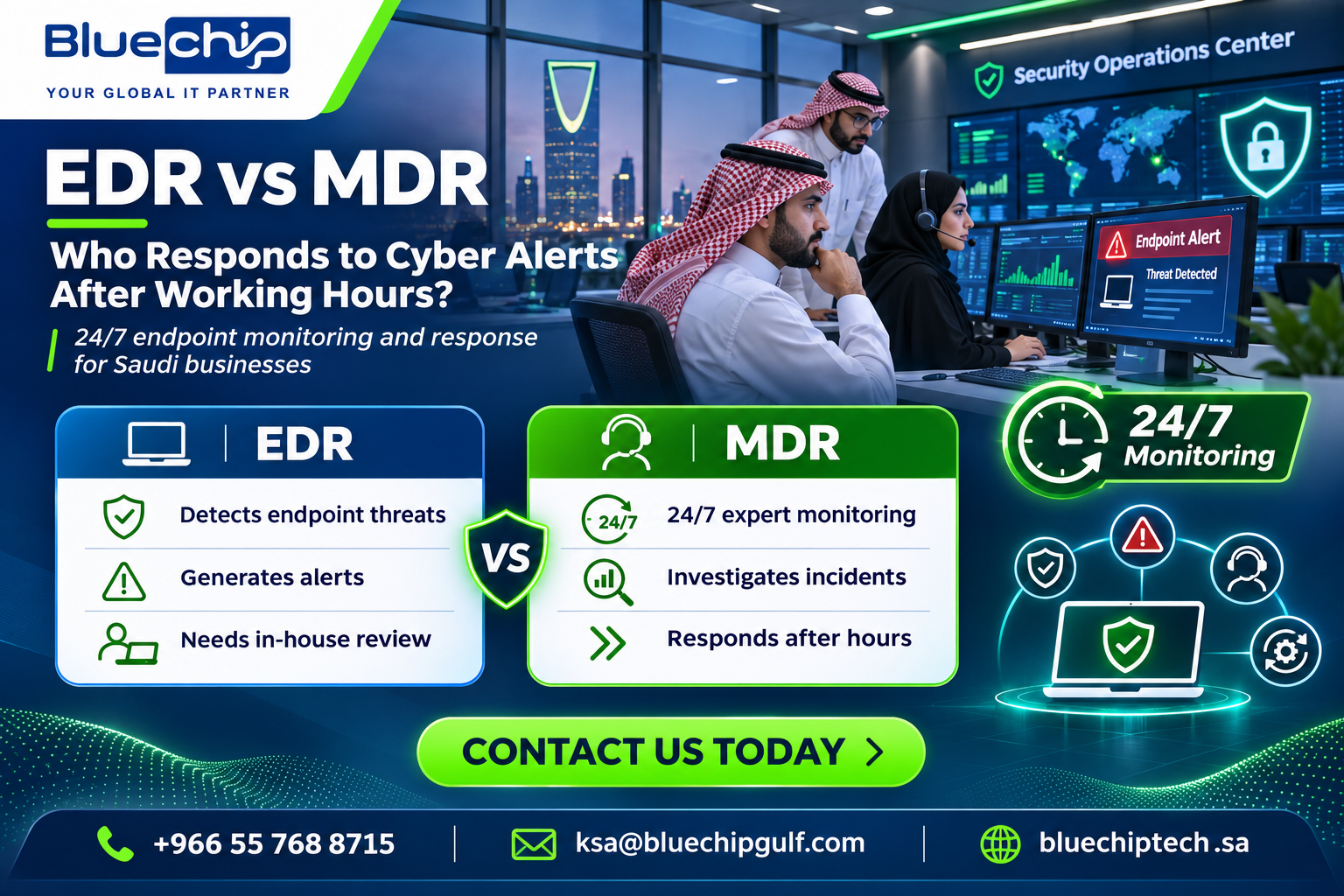
EDR vs MDR for Saudi Businesses: Who Responds to Cyber Alerts After Working Hours?
Introduction
While many businesses operate set times for work, malicious behaviour can be initiated at any time including late evening, weekends and public holidays. If Saudi Arabian businesses fail to recognise and manage such behaviour then this can impact on their business.
Both EDR and MDR can assist businesses in recognising and responding to endpoint-based risks. Although these two options are similar, MDR goes further than EDR and incorporates expert staff into the process so that alerts can be monitored and investigated.
Recognising these key variations can enable Saudi businesses to establish who will investigate and manage their cyber alerts when in-house IT personnel are not available.
1. What is Endpoint Detection and Response (EDR)?
EDR is a form of cyber-security which allows an organisation to monitor endpoint equipment (including laptops, desktops and servers) to recognise and analyse possible risky behaviour.
Unlike conventional anti-virus programmes, EDR provides a constant stream of data relating to endpoints and analyses this to recognise risks. This can then be utilised by members of an organisation’s security team to investigate and analyse how a cyber-incident may have occurred.
Common features of EDR include:
- Monitoring endpoint behaviour.
- Analysing behaviour to recognise risk.
- Detecting malware and ransomware.
- Investigating and analysing risks.
- Managing and responding to risk.
- Generating and managing alerts.
If staff download what appears to be an inappropriate file outside normal working hours, for example, an EDR system could recognise this and issue an alert. Again, however, further investigation may have to be postponed until in house security personnel are available, unless automatic management processes or external monitoring is in operation.
2. What is Managed Detection and Response (MDR)
Together with cyber-security technology, MDR involves expert personnel. Rather than always depend on in-house IT staff to investigate alerts, companies can access an external security monitoring service
Generally, MDR includes Endpoint Monitoring, investigation of alerts and threat hunting. Again, this will often depend on the terms of the MDR service contract and the scope of provision.
At midnight, for example, if an MDR service recognises behaviour which may indicate that ransomware is being used, expert members of the MDR service can analyse and determine the seriousness of this and then implement pre-defined responses. There is therefore no need to await the availability of a company’s normal IT personnel.
Consequently MDR is especially favourable for Saudi Arabian businesses which wish to implement 24/7 Endpoint Monitoring, but lack a 24/7 in house security monitoring function.
3. Who Investigates and Manages Cyber Alerts?
Outside normal working hours, the core difference between EDR and MDR is who investigates and manages alerts.
Whilst EDR enables an organisation to recognise and analyse risky behaviour, it is predominantly the company’s in house IT or security personnel who then investigate and manage cyber alerts (unless automatic processes or external services are adopted)
Meanwhile, with MDR, expert personnel investigate alerts and analyse risks in line with the extent of the MDR service. They can also manage and implement responses to incidents as permitted.
For Saudi Arabian businesses with varied working shifts or those that run essential business software, this can have a major impact on how well an organisation can investigate and manage cyber incidents.
4. Why Do Saudi Businesses Need 24/7 Endpoint Monitoring?
As Saudi Arabian businesses become ever more digitally connected, using items such as smart-technology, cloud and digital software, there are increased opportunities for cyber criminals to target endpoints and illegally access a business’s systems.
Ongoing Endpoint Monitoring can allow an organisation to:
- Recognise risky behaviour at endpoints.
- identify potential ransomware and malware usage.
- Investigate anomalous log-ins.
- Respond to risks more swiftly.
- Enhance awareness of its endpoint equipment.
- Enhance both business continuity and security functions.
In particular, sectors such as banking, healthcare, retail and oil and gas may gain particular advantages from tailoring their monitoring provision to suit their business needs.
5. When Should EDR or MDR Be Adopted?
EDR could be appropriate for an organisation if it has competent in-house IT or cyber-security personnel who can investigate and manage alerts and responses.
By contrast, MDR may be preferable for companies who lack in house security knowledge, which work outside normal business hours or which require 24/7 monitoring provision.
In some cases, businesses may even wish to utilise both EDR and MDR. As well as offering Endpoint Monitoring and detection functionality, EDR can therefore be supplemented by MDR’s expert monitoring and management provision.
The most appropriate option will largely depend on an organisation’s size, its degree of risk exposure and its resource availability. Alongside these factors, the extent of desired security provision should also be considered.
6. What to Consider When Assessing MDR Services?
Saudi Arabian businesses (and indeed those in other regions) should consider the following elements when assessing MDR services:
- Whether true 24/7 monitoring is provided.
- Who investigates and confirms alerts.
- What responses can be implemented.
- Whether endpoint quarantining is offered.
- How alerts and incidents are escalated to in house personnel.
- What reporting and communication facilities exist.
- Whether integration with an organisation’s current security provision can be achieved.
Furthermore, businesses should examine the terms of any service level agreement (SLA) in order to ascertain information regarding response provisions, roles and boundaries.
Enhance Your Business Cyber Security with Bluechip Saudi Arabia
In deciding between EDR and MDR, it is vital for an organisation to recognise who is monitoring its computer systems, investigating risks and managing cyber incidents, particularly outside normal business hours.
Bluechip Saudi Arabia can assist Saudi Arabian businesses to enhance their cyber security provision by offering endpoint, detection and managed security services. Whethere you require EDR or extra monitoring provision, identifying the most appropriate security method can further boost an organisation’s awareness and preparedness in relation to cyber incidents.
Seeking endpoint detection and response services in Saudi Arabia?
Please get in touch with Bluechip Saudi Arabia to advise on your cyber security needs and to explore options for further strengthening your business’ cyber security provision, even beyond normal business hours.
FAQ
01. What is the difference between EDR and MDR?
Endpoint Detection and Response (EDR) is a security solution that monitors activity across laptops, workstations and servers to identify suspicious behaviour, investigate threats and, where configured, contain potential attacks. Managed Detection and Response (MDR) goes a step further by providing security analysts who monitor alerts, investigate suspicious activity and help businesses respond to threats using EDR and other security tools. Extended Detection and Response (XDR) brings together security information from multiple sources, including endpoints, email, networks and user identities. The key difference is who handles the alerts.
An EDR licence provides security technology, but it does not automatically include round-the-clock human monitoring. MDR adds professional monitoring and response support, although the level of service varies between providers. Saudi businesses should check what is included in the agreement, particularly monitoring hours, investigation responsibilities and the authority to take action.
02. Who responds when an endpoint security alert appears at midnight?
The response depends on the security service a business has chosen. If a company only uses EDR software, an alert may remain unattended until its internal IT or security team reviews it the next morning, unless an automated rule takes action first. With a genuine 24/7 MDR service, security analysts should be available to investigate alerts, assess potential threats and follow the agreed escalation process. Before signing an agreement, businesses should clarify whether the provider can isolate an affected device or must first seek approval.
They should also establish who receives urgent notifications if a serious incident occurs outside office hours. These responsibilities should be clearly documented in the service agreement. Running a simulated after-hours security incident can also help confirm that everyone understands their role.
03. Does a Riyadh business need 24/7 monitoring if it already has endpoint antivirus?
Antivirus software is an important part of endpoint security, but having it installed does not guarantee that suspicious activity will be investigated outside working hours. Businesses with internet-facing applications, remote employees, sensitive customer information or operations that continue overnight may benefit from continuous security monitoring. Even a smaller organisation can face serious disruption if an attacker gains access over the weekend and remains undetected until employees return on Monday. The right level of protection depends on the company’s security risks, internal IT resources and the possible impact of a delayed response. Businesses can compare an internal on-call team, automated EDR responses and outsourced MDR services to find a suitable approach.
Before choosing MDR, they should confirm that the provider can monitor the relevant endpoints, explain how alerts are prioritised and outline how incidents are handled from detection through to resolution.
04. What incident-response responsibilities remain with a Saudi business after outsourcing MDR monitoring?
Outsourcing security monitoring does not mean a business can hand over all responsibility for cybersecurity. The organisation remains responsible for managing its security risks, controlling employee access, protecting important systems and deciding which operations should take priority during an incident. An MDR provider may monitor systems, investigate alerts and carry out agreed containment actions, but the business may still need to approve decisions that could interrupt operations, coordinate with internal teams and determine when affected systems are ready to return to service. It should also assign an internal owner to assess and handle any applicable legal or regulatory notification requirements.
A shared incident-response plan should cover emergency contact details, escalation procedures, permitted containment actions, evidence retention, backup restoration and communication with customers or regulators where necessary. Saudi businesses should also identify the cybersecurity and sector-specific requirements that apply to their organisation, as outsourcing MDR monitoring does not automatically transfer those obligations to the service provider.


