



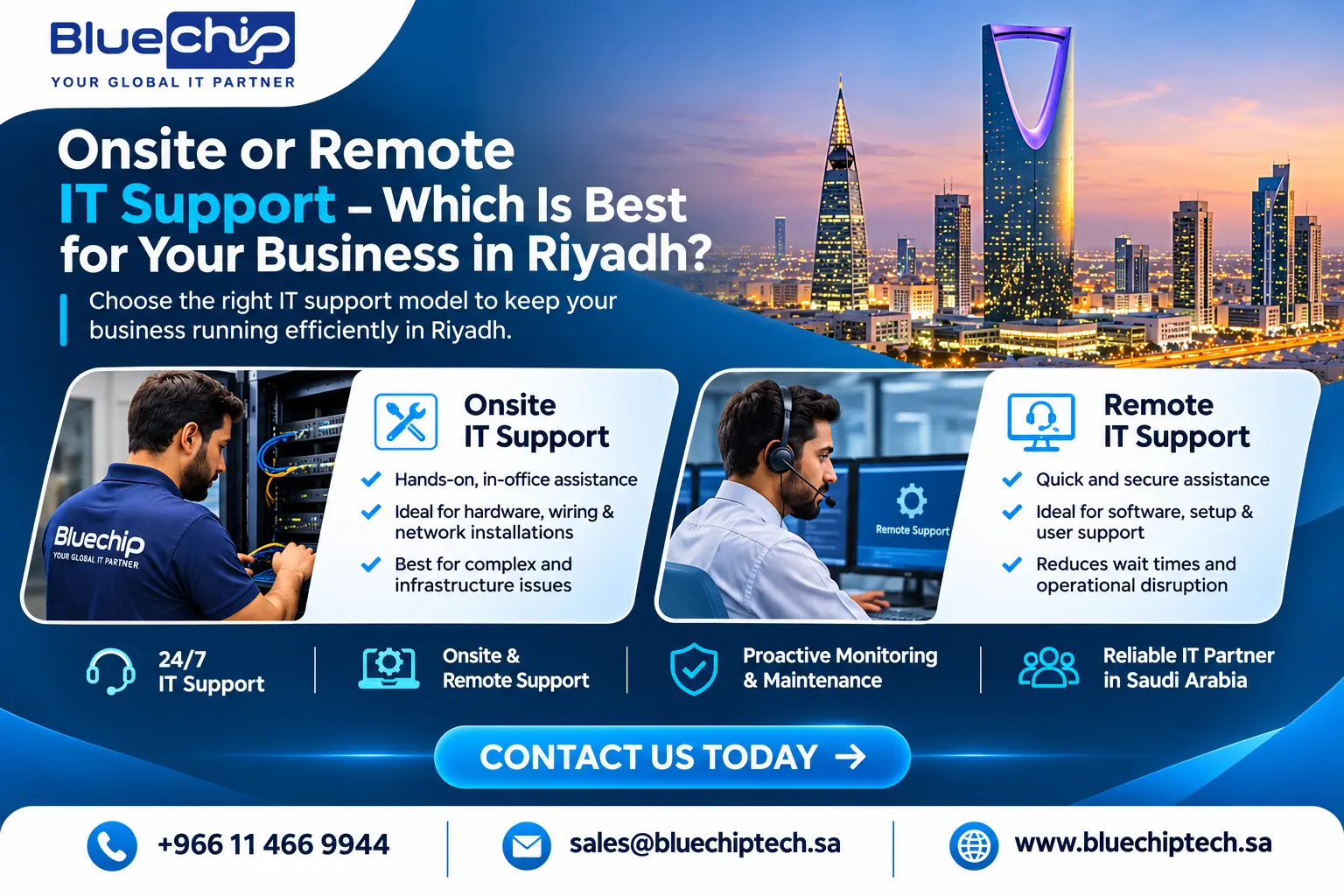
Onsite or Remote IT Support – Which Is Best for Your Business in Riyadh?
Technology plays a key role within any business in Riyadh to ensure day-to-day processes run efficiently. However, technical issues can cause disruption to operations, including network issues, software glitches, hardware failure and security threats. Choosing the correct IT support model will help to keep your systems running effectively.
Should you choose onsite or remote IT support? Here are some key points to consider. With professional IT Support 24/7 KSA you’ll have technical assistance available.
What is Onsite IT Support?
Onsite IT support refers to qualified IT staff visiting you at your office. This type of support is ideal for technical issues where onsite support is required.
If your business is having issues with hardware, wiring, servers or needing network installation then onsite IT support will be required. Having a qualified IT technician onsite to check for issues will allow them to easily identify any issues related to your equipment.
Having onsite IT support in Riyadh offices with lots of IT infrastructure will help with installations, maintenance, repairs and complex issues.
What is Remote IT Support?
Remote IT support means that your technician can help to identify and fix technical issues without visiting your site. Secure remote tools can be used to help with software issues, setup, employee assistance and updates.
This is great for businesses who want to reduce wait times for technical support. Employees can get help with applications, login issues, OS errors and common issues.
With professional 24/7 IT Support Services in Saudi Arabia businesses will have access to technical support outside of normal hours. Remote IT support is great for businesses with several offices.
Onsite vs Remote IT Support
The main difference between onsite and remote IT support is how technical issues are resolved.
Remote IT support is ideal for software issues, setup, general maintenance and technical issues that can be resolved via secure online access. This can help to reduce onsite visits and get employees back up and running quicker.
Onsite IT support is needed if there are hardware issues, wiring issues, installations and technical issues which need to be identified onsite. Whilst onsite support can take longer to organise it can provide direct assistance.
Remote IT support can help to save on travel costs and frequent visits from technicians. Onsite support may incur additional charges for the service provided depending on the issue and SLA.
However, it may be best to consider using a mixture of onsite and remote IT support.
Which IT Support Is Right for Your Business in Riyadh?
It really depends on the size of your business, IT infrastructure, number of employees and what is important to you.
Small and medium sized businesses may find remote support helps with general IT issues. However, if there are issues with equipment or infrastructure onsite support may be required. For larger businesses with several departments, servers and complex networks a mixture of onsite and remote support may be required.
Many businesses in Riyadh will benefit from using a mixture of onsite and remote support. Issues can be investigated by remote technicians and fixed quickly if applicable. If onsite support is needed then engineers can attend to faults.
Working with a reliable company who provide IT Support 24/7 KSA can help with this. Proactive monitoring, regular maintenance, updates and clear response times can help to reduce any unexpected disruptions.
Choose Bluechip for Reliable IT Support in Saudi Arabia
To ensure your employees are kept productive, systems are secure and everything runs as smoothly as possible, you’ll need to have an IT support strategy in place. Whether you need remote or onsite support, choosing the right partner can really make a difference.
We provide onsite and remote IT support solutions to suit your business. We can offer 24/7 technical support, proactive monitoring, troubleshooting and infrastructure support.
Don’t let regular technical issues hold your business back. Get in touch with Bluechip Tech Saudi today to discuss your IT needs and see how our 24/7 IT Support Services in Saudi Arabia can help your business in Riyadh reduce downtime, increase efficiency and keep your IT running effectively.
FAQ
What is the difference between onsite and remote IT support?
Remote support resolves issues through secure remote-management, administration, monitoring, and communication tools without a technician being physically present. Onsite support places a technician at the business location when hardware, cabling, physical infrastructure, or hands-on diagnostics are required. Effective IT support often combines both: remote support for fast triage and routine fixes, with onsite escalation when physical intervention is necessary.
Which IT problems require onsite support?
Onsite support is commonly required for failed physical hardware, structured cabling faults, rack and server-room work, device installation, network equipment replacement, office moves, physical connectivity problems, and incidents that cannot be safely diagnosed remotely. The decision should be based on the fault, security requirements, business impact, and whether remote troubleshooting can resolve the issue without unnecessary delay.
Can remote IT support handle business-critical problems?
Many critical incidents can be triaged remotely, and some can be fully resolved through secure administrative access, configuration changes, service restoration, or cloud management. However, remote support is not a substitute for physical intervention when hardware or connectivity has failed. A mature support model defines escalation rules so high-impact incidents move quickly from remote diagnosis to onsite action when required.
What should be included in an IT support SLA?
An SLA should define service hours, supported systems and locations, incident priorities, response targets, resolution or restoration targets where appropriate, escalation paths, communication expectations, maintenance windows, exclusions, onsite coverage, reporting, and responsibilities of both parties. It should also explain how priority is determined and how performance is measured. Clear definitions are more useful than broad promises such as ’24/7 support’ without scope or targets.


