



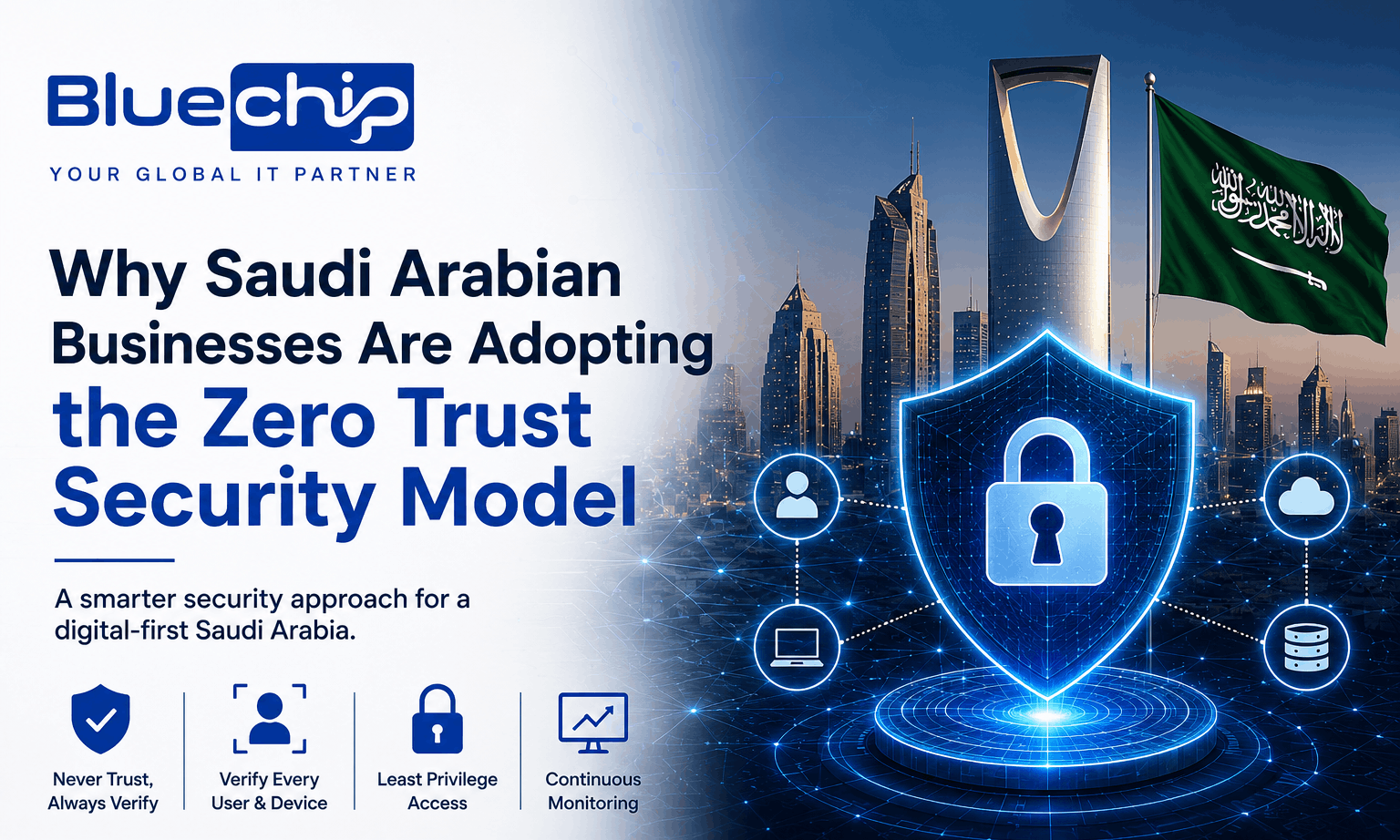
Why Saudi Arabian Businesses Are Adopting the Zero Trust Security Model
Cybersecurity threats are evolving faster than ever across Saudi Arabia. As organizations rapidly embrace cloud computing, hybrid work environments, smart office technologies, and digital transformation initiatives aligned with Vision 2030, traditional security approaches are no longer sufficient to protect modern business operations.
In the past, businesses primarily relied on perimeter-based security using firewalls and antivirus software. Once users entered the corporate network, they were generally trusted automatically.
However, today’s cyber threats have completely changed the landscape.
Modern attackers can bypass traditional defenses through:
- Phishing attacks
- Stolen credentials
- Remote access vulnerabilities
- Insider threats
- Cloud security gaps
This is why businesses across the Kingdom are increasingly adopting the Zero Trust Security Model.
Organizations investing in managed IT services in Saudi Arabia are implementing Zero Trust strategies to strengthen access control, improve visibility, and proactively reduce cyber risks.
What is the Zero Trust Security Model?
Zero Trust is a cybersecurity framework built on one simple principle:
“Never Trust, Always Verify.”
Instead of automatically trusting users or devices within the network, Zero Trust continuously verifies every access request before granting permission.
This applies to:
- Employees
- Devices
- Applications
- Servers
- Remote users
- Cloud environments
Every connection request is treated as potentially suspicious until it has been verified.
Why Traditional Security Models Are No Longer Enough
Traditional security architectures were designed for businesses where:
- Employees worked mainly from the office
- Applications were hosted on-premises
- Devices remained within corporate networks
Today’s business environment is very different.
Organizations now rely heavily on:
- Cloud platforms
- Remote and hybrid workforces
- Mobile devices
- SaaS applications
- Third-party integrations
- Smart office technologies
These technologies create multiple entry points for cybercriminals, making identity-based security more important than ever.
Core Principles of Zero Trust Security
1. Verify Every User and Device
Every access request must be authenticated before access is granted.
This includes:
- Multi-Factor Authentication (MFA)
- Device verification
- Identity validation
- Behavioral analysis
Even internal employees must continuously verify their identity.
2. Least Privilege Access
Users receive access only to the systems and information required for their specific role.
This reduces the risk of:
- Insider threats
- Compromised accounts
- Unauthorized access
Limiting permissions significantly strengthens organizational security.
3. Continuous Monitoring
Zero Trust environments continuously monitor:
- User activity
- Network traffic
- Endpoint behavior
- Cloud access
- Application usage
Any suspicious behavior triggers alerts and automated security responses.
Organizations using managed IT services in Saudi Arabia increasingly rely on continuous monitoring to improve threat detection and response.
4. Assume Breach
Zero Trust assumes attackers may already exist inside the network.
Rather than depending solely on perimeter defenses, businesses focus on:
- Network segmentation
- Limiting lateral movement
- Monitoring internal traffic
- Detecting suspicious behavior early
This minimizes the impact of successful cyberattacks.
Why Saudi Arabian Businesses Are Adopting Zero Trust
Organizations throughout Riyadh, Jeddah, Dammam, Khobar, and other major cities are rapidly modernizing their IT environments.
Businesses increasingly depend on:
- Cloud infrastructure
- Remote employees
- Smart office technologies
- IoT devices
- Digital collaboration platforms
Traditional security models struggle to protect these modern environments effectively.
Zero Trust provides stronger protection for today’s connected businesses while supporting Saudi Arabia’s digital transformation goals.
Key Benefits of Zero Trust Security
Better Protection Against Cyberattacks
Zero Trust significantly reduces the risk of:
- Ransomware
- Credential theft
- Insider threats
- Unauthorized access
- Data breaches
Continuous verification creates a much stronger security posture.
Stronger Remote Work Security
Remote employees increase the attack surface for cybercriminals.
Zero Trust secures remote access by continuously validating:
- User identity
- Device health
- Access permissions
- Connection behavior
This makes hybrid work significantly more secure.
Improved Cloud Security
As businesses migrate to cloud platforms, identity-based access becomes increasingly important.
Zero Trust improves cloud security through:
- Identity-based authentication
- Secure access management
- Cloud activity monitoring
- Application-level protection
This helps organizations protect sensitive business data.
Reduced Lateral Movement
If attackers compromise one system, Zero Trust prevents them from easily moving across the network.
This limits operational disruption and reduces the overall impact of cyber incidents.
Better Compliance
Organizations handling sensitive information require stronger security controls to meet regulatory requirements.
Zero Trust supports:
- Audit readiness
- Access governance
- Activity logging
- Security reporting
This helps businesses improve compliance with industry standards and cybersecurity regulations.
Why Infrastructure Still Matters
Zero Trust relies on a strong and secure IT foundation.
Businesses require:
- Reliable networking
- Secure endpoints
- Enterprise servers
- Advanced monitoring
- Scalable infrastructure
Working with an experienced IT Infrastructure Solution Provider in Riyadh helps organizations build secure, resilient, and future-ready IT environments that support Zero Trust implementation.
The Role of Hardware in Cybersecurity
Enterprise-grade infrastructure remains a critical component of cybersecurity.
Organizations should invest in:
- Next-generation firewalls
- Enterprise switches
- Secure servers
- Endpoint devices
- Wireless networking
- Security monitoring systems
Reliable infrastructure improves both cybersecurity and overall business performance.
Industries Adopting Zero Trust in Saudi Arabia
Zero Trust is increasingly being adopted across:
- Banking & Financial Services
- Healthcare
- Government
- Retail
- Manufacturing
- Logistics
- Education
- Enterprise Organizations
These industries manage highly sensitive operational and customer information every day.
Signs Your Business Needs Zero Trust
Your organization may benefit from Zero Trust if you experience:
- Hybrid workforce security challenges
- Increasing phishing attacks
- Limited cloud visibility
- Multiple remote users
- Sensitive business data
- Insider security risks
- Complex IT environments
These are clear indicators that traditional security approaches may no longer provide adequate protection.
Why Saudi Businesses Are Modernizing Cybersecurity
Organizations throughout Saudi Arabia are prioritizing:
- Identity-first security
- Cloud-first infrastructure
- Continuous monitoring
- Secure remote access
- Centralized visibility
- Zero Trust architecture
Many businesses are also partnering with providers offering IT Infrastructure Services Riyadh to modernize their networks while improving operational resilience and cybersecurity.
Why Businesses Trust Bluechip Saudi Arabia
Modern cybersecurity requires far more than antivirus software and traditional firewalls.
Organizations need:
- Reliable IT infrastructure
- Secure networking
- Continuous monitoring
- Enterprise-grade hardware
- Advanced cybersecurity integration
- Managed IT support
Bluechip Saudi Arabia helps organizations strengthen their cybersecurity posture through enterprise networking, secure infrastructure deployment, endpoint protection, cloud security, and managed IT solutions.
With expertise in managed IT services in Saudi Arabia, Bluechip enables businesses to build secure, scalable, and future-ready digital environments aligned with their business objectives.
Final Thoughts
As organizations across Saudi Arabia continue adopting cloud technologies, hybrid work, AI-driven applications, and digital transformation initiatives, traditional perimeter-based security models are becoming increasingly ineffective.
The Zero Trust Security Model offers a proactive and intelligent approach by continuously verifying users, devices, and every access request before granting trust.
Businesses that invest in secure infrastructure, continuous monitoring, identity-based security, and experienced technology partners like Bluechip Saudi Arabia will be better positioned to defend against evolving cyber threats while supporting long-term business growth and innovation.


