


What’s Next for IT Services in Saudi Arabia? Exploring AI, Edge & Hybrid Cloud
The ambitious Saudi Vision 2030 roadmap is driving a remarkable digital revolution in Saudi Arabia. This is about creating a completely new digital economy, not just updating outdated systems. Diversification, creating smart cities like NEOM, and quickly digitizing public services are the main priorities. The development of IT services in Saudi Arabia is at the center of this change.
In Saudi Arabia, the need for sophisticated, proactive, and strategic IT solutions is displacing the conventional break-fix support model. Three key technologies, Edge Computing, Hybrid Cloud architectures, and Artificial Intelligence (AI), will define the next stage of growth.
It is crucial for companies and governmental organizations in the Kingdom to comprehend and use these technologies. It’s the distinction between actually innovating and just operating. Managed IT services in Saudi Arabia are becoming a valuable strategic alliance as a result of this change.
Table of Contents
The Foundation – Vision 2030 and Digital Mandates

The Saudi Arabian government is solely responsible for the country’s digital boom. Vision 2030 calls for the modernization of all industries, including energy (oil and gas), healthcare, and finance (BFSI).
The Drivers of the IT Market Growth –
1. Huge Government Spending – The Kingdom spends billions of dollars a year on ICT and digital transformation initiatives, which opens up a plethora of opportunities for IT Services in Saudi Arabia.
2. Smart City Mega-Projects (NEOM) – Developed from the ground up on cutting-edge digital infrastructure, NEOM and The Line serve as living laboratories for edge computing, AI, and the Internet of Things.
3. Digital Government Services – The standard for digital maturity has been raised by platforms such as Absher and Nafath. The objective is to offer fully integrated, citizen-focused digital services, encouraging Saudi Arabia’s top-notch IT solutions across all sectors.
The market is moving away from basic on-site IT support services and toward specialized, technology-driven solutions due to the enormous demand for advanced technical support created by this environment.


The Intelligence Engine – Artificial Intelligence (AI)
Driven by the National Strategy for Data and Artificial Intelligence (NSDAI), artificial intelligence is the most important strategic pillar of Saudi Arabia’s digital future. The objective is to become a global leader in AI development, not just to use AI.
The Role of AI in IT Services
AI is radically altering the provision of managed IT services in Saudi Arabia –
- Predictive Maintenance (Proactive IT Services) – Predictive maintenance, also known as proactive IT services, uses real-time performance data analysis by AI tools to anticipate server failures before they happen. This reduces downtime by changing IT support from reactive to proactive.
- Security and Threat Detection – AI-driven security systems are able to identify anomalous patterns that indicate a cyber threat by analyzing billions of data points. This enables automated responses and real-time threat detection, which is crucial as cloud adoption increases cybersecurity vulnerabilities.
- Automation and Efficiency (Agentic AI) – Repetitive IT tasks like handling support tickets, fixing frequent system issues, and allocating resources optimally are being automated by AI agents. Human IT Support Services employees can now concentrate on intricate, high-value strategy and innovation.
- Localizing AI – Projects supported by the Public Investment Fund (PIF) and international partners (such as Google Cloud) are establishing AI hubs to develop Arabic-optimized large language models (LLMs) and industry-specific AI for industries such as energy and finance.
The Flexible Backbone – Hybrid Cloud Architecture

In the Kingdom, cloud adoption is skyrocketing due to the demand for cost-effectiveness and scalability. However, a Pure Public Cloud model is not practical for many important sectors due to stringent data sovereignty laws that require sensitive data to remain within Saudi Arabia’s borders. As a result, the Hybrid Cloud has become the norm.
Why Hybrid Cloud is Key in Saudi Arabia
A hybrid cloud combines one or more adaptable public clouds (such as AWS, Azure, or Google Cloud) with a secure private cloud (or on-premises data center).
1. Data Sovereignty and Compliance – Private, in-country clouds can safely store sensitive data, including government records, health data, and financial customer information, while still adhering to all legal requirements.
2. Scalability and Innovation – The public cloud allows for rapid scaling and pay-as-you-go access to new, cutting-edge tools (such as AI platforms) for non-sensitive applications, testing environments, and high-demand services.
3. Optimization – By putting workloads where they are most effective, cost-sensitive workloads on the public cloud and performance/security-sensitive workloads on the private cloud, a hybrid approach enables businesses to optimize costs.
Top IT Solutions in Saudi Arabia providers now focus on multi-cloud strategies, which use services from several public cloud providers concurrently and seamlessly integrate them into a single framework for managed IT services in Saudi Arabia.
The Speed Enabler – Edge Computing
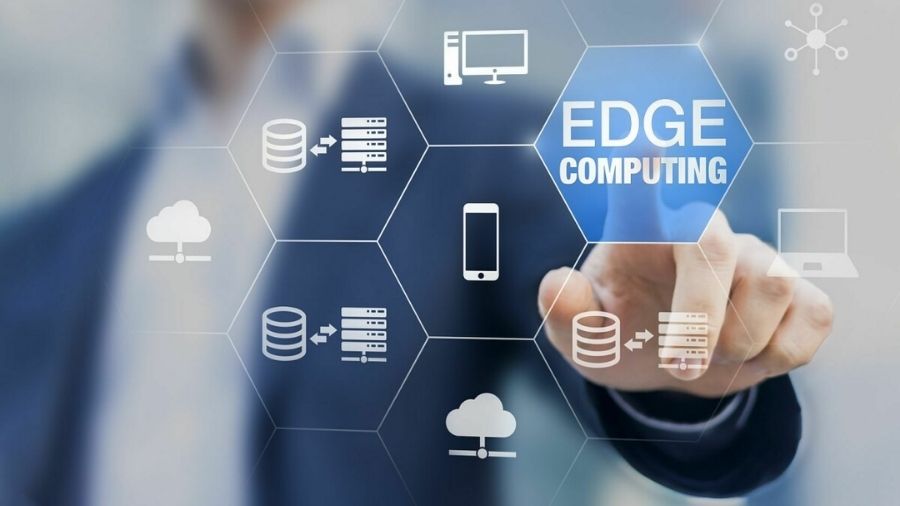
The need for speed becomes critical as AI and digital services become indispensable. Edge computing is useful in this situation.
What is Edge Computing?
Traditionally, data from a sensor or device (such as an oil rig sensor or a smart city camera) is transmitted all the way back to a central data center, which may be hundreds of kilometers away, for processing. This results in latency, or a delay.
In edge computing, the processing power (a tiny server or mini-data center) is brought much closer to the “edge” of the network, where the data is actually collected.
Edge Computing’s Impact on IT Services
Mega-projects in Saudi Arabia depend on edge computing –
1. Real-time Decision Making – Autonomous vehicles and traffic control systems must make decisions in milliseconds in smart cities like NEOM. This allows for immediate responses thanks to edge AI (AI algorithms operating on the edge device).
2. IoT and Industrial Applications – Sensors on pipelines and machinery utilize the Edge to process data immediately for predictive supervision, controlling catastrophic failures with zero delay, in the oil and gas industry, which is a major driver of IT services in Saudi Arabia.
3. Improved On-site IT Support Services – Since traditional server rooms are not practical in remote or industrial locations, edge devices are frequently installed there. To install, maintain, and secure these new, ruggedized compute devices outside the main office, on-site IT Support Services teams now need to have the necessary tools.
Edge gathers and processes data quickly, Hybrid Cloud offers scalable storage and sophisticated analysis, and AI gathers intelligence from the data to create a potent loop.
The Evolving Role of Managed IT Services in Saudi Arabia

The function of managed IT services in Saudi Arabia is changing fundamentally in this intricate, multi-layered environment. These three convergent technologies are now too complex for businesses to handle independently.
The New Mandate for IT Solutions Providers –
1. Orchestration, Not Just Management – In order to effectively manage workloads, security regulations, and cost control across various cloud and on-premises environments, providers must master Hybrid Cloud Orchestration.
2. Security-First Approach – Since data is dispersed throughout the Edge, Private Cloud, and Public Cloud, security needs to be incorporated into each layer (also referred to as Zero Trust Architecture). Advanced, AI-powered cybersecurity must be a key component of IT Solutions in Saudi Arabia.
3. The New On-site IT Support – While traditional on-site IT support services are still crucial, their expertise needs to change. They require knowledge of how to integrate physical infrastructure with cloud APIs, manage local data residency rules, and secure Edge devices.
4. Talent and Training – The lack of specialized AI, Cloud, and Edge talent is the Kingdom’s biggest problem. In line with the country’s objective of creating a knowledge-based economy, managed IT services in Saudi Arabia will actively invest in training their local staff.
The next phase of IT services in Saudi Arabia will involve strategic alignment with the country’s vision rather than merely implementing technology. Bluechip Tech enables businesses in the Kingdom to take the lead in the global digital economy by leveraging the speed of edge computing, the flexibility of hybrid cloud computing, and the power of artificial intelligence.
Also Read: 5G Cybersecurity Risks – What It Means for Saudi Businesses


