




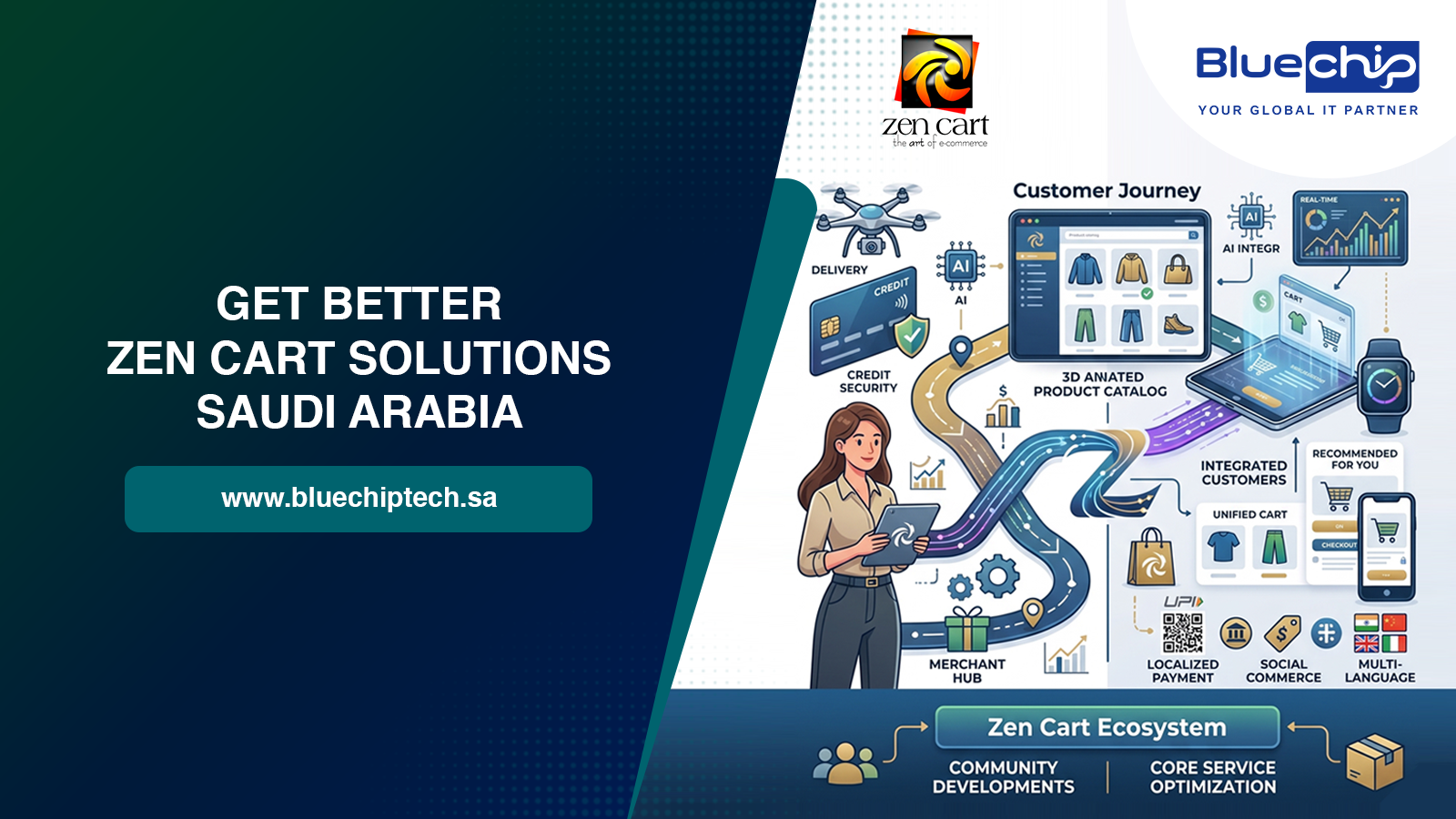
Zen Cart E-Commerce Development for Riyadh Businesses
Bluechip Advanced Technologies supports new Zen Cart stores and existing-store improvements for businesses in Riyadh and across Saudi Arabia. The right scope depends on your current version, catalog, custom code, payment and shipping requirements, language needs, reporting and hosting environment.
What Is Zen Cart?
Zen Cart is an open-source shopping cart and online-store platform for merchants that want control over hosting, storefront code, catalog structure and extensions. It runs on a supported PHP-based web stack and provides core commerce functions for product management, pricing, customer accounts, checkout and order administration.
What Makes Zen Cart Different?
Zen Cart is self-hosted and open source, so a business can retain more control over its codebase and hosting than with a fully hosted SaaS platform. Its template system, plugins and developer hooks allow stores to be extended for specific catalog, pricing, checkout and integration requirements. That flexibility also creates responsibility: hosting, updates, extension compatibility, backups and security need active management.
Why Consider Zen Cart?
1. Control over the store environment — useful when the business needs self-hosting, code access or custom workflows.
2. Practical continuity for existing Zen Cart stores — an audit and staged upgrade may preserve valuable data and custom functionality without forcing a platform change.
Core Zen Cart Capabilities
• Catalog and product management — organize categories, product information, images, attributes and inventory-related settings.
• Pricing and promotions — support pricing rules, specials, discounts and customer/group pricing scenarios available within the platform.
• Multiple languages and currencies — configure the storefront for more than one language or currency where the required language packs and theme components are compatible.
• Payment and shipping options — use supported modules or suitable integrations for the providers required by the business.
• Templates, plugins and custom development — extend the storefront and administration features without treating the platform as a fixed template.
• Customer and administration controls — manage customer accounts, store administration and access-related settings according to the implementation
Store Reporting and Performance Visibility
Reporting should answer operational questions, not simply show activity. Depending on the store setup, Zen Cart’s admin information can be complemented with suitable analytics or reporting extensions to monitor sales, top products, checkout behaviour, campaign traffic and other agreed KPIs. The reporting stack should be selected around the decisions the business actually needs to make.
Upgrades, Security and Maintenance
An existing Zen Cart store should be reviewed before any major upgrade. Check the core version, PHP and database compatibility, installed extensions, template overrides, custom code, backup process and hosting environment. Test upgrades in staging first, then validate checkout, payment, shipping, emails, customer accounts and admin workflows before production deployment.
Zen Cart Services from Bluechip Advanced Technologies
Bluechip Advanced Technologies can assess an existing Zen Cart store or scope a new build. Work may include installation and configuration, theme customization, catalog setup, plugin/module integration, payment or shipping integration, data migration, upgrade work, troubleshooting and ongoing maintenance. Any third-party integration should be confirmed against the provider’s current API or module compatibility before implementation.
Planning a Zen Cart Project in Saudi Arabia?
Zen Cart Development Services We Provide
A Zen Cart project can range from a focused upgrade to a fully customized storefront. The right scope depends on the current codebase, catalog, integrations, operating workflow and future roadmap.
• New Zen Cart store setup — installation, configuration, catalog structure and essential store settings on a compatible hosting environment.
• Theme and storefront customization — adapt the customer-facing experience to the brand, product range, navigation and mobile requirements.
• Plugin and module integration — evaluate, configure or extend suitable modules for business functions that are not covered by the required core setup.
• Payment and shipping integration — assess provider compatibility and connect supported gateways, shipping services or custom APIs where technically feasible.
• Upgrade and modernization — review the current Zen Cart version, PHP/database compatibility, extensions and custom overrides before planning a staged upgrade.
• Migration and data work — plan controlled transfer of products, customers, orders or other store data when moving from an older installation or another platform.
• Troubleshooting and maintenance — investigate errors, extension conflicts, performance bottlenecks and routine maintenance requirements for existing stores.
Is Zen Cart the Right Fit for Your Store?
Zen Cart can be a practical choice when a business wants a self-hosted open-source store, needs access to the codebase, already operates a Zen Cart estate, or has catalog and pricing requirements that can be handled through core features and suitable extensions. It can also make sense when the business prefers to own the hosting relationship rather than depend entirely on a hosted commerce platform.
It may not be the best fit when the priority is a fully managed SaaS experience with minimal technical administration, or when a project depends on a specific marketplace, ERP, payment or logistics integration that is better supported on another platform. Platform selection should follow the business requirements, not the other way around.
Planning a Zen Cart Store for Saudi Arabia
A Saudi e-commerce implementation needs more than a theme and product catalog. Before development starts, confirm the operating requirements that affect checkout, administration and ongoing support.
• Arabic and English experience — Zen Cart supports multiple languages, but Arabic copy, right-to-left presentation, fonts, templates and extension screens should be tested in the actual theme and plugin stack.
• Payments and delivery — confirm the selected payment provider, settlement flow, shipping/carrier requirements and whether a supported module or API integration is available.
• E-invoicing where applicable — if the business is subject to ZATCA FATOORA requirements, the store or connected billing workflow should be designed to work with a compliant e-invoicing solution. Do not assume Zen Cart is compliant by default.
• Customer data handling — review collection, access, retention and third-party integrations against the business’s applicable privacy obligations.
• Hosting and security — use a supported server stack, HTTPS, reliable backups, controlled admin access, current extensions and a tested update process.
Our Zen Cart Implementation Approach
1. Discover and audit — confirm goals, catalog, current version, custom code, integrations, language, hosting and known issues.
2. Design the solution — define storefront changes, technical architecture, modules/integrations, migration approach, security controls and test plan.
3. Build and test — configure and customize in a controlled environment, then test checkout, payments, shipping, emails, customer accounts, responsive behaviour and admin workflows.
4. Launch and maintain — plan deployment, backups, rollback readiness, monitoring, documentation and a realistic maintenance path.
Why Work with Bluechip Advanced Technologies for Zen Cart?
• Requirements before development — define catalog, checkout, integrations, language, administration and maintenance needs before selecting extensions or custom code.
• Existing-store assessment — review version, hosting, plugins, template overrides and customizations before recommending an upgrade or rebuild.
• Integration-aware planning — confirm payment, shipping, analytics, invoicing or business-system requirements early so they can be tested against current compatibility.
• Security and maintenance consideration — include updates, backups, permissions, HTTPS, hosting compatibility and extension hygiene in the project plan.
• Connected services — where relevant, coordinate the store with related Bluechip web design, hosting and security services.
FAQ
What is Zen Cart?
Zen Cart is a free, open-source e-commerce platform for building and managing an online store. It is PHP-based, uses a database such as MySQL/MariaDB on supported environments, and includes core features for catalog, pricing, checkout, orders and store administration.
Is Zen Cart still supported and actively maintained?
Yes. Zen Cart remains an active open-source project with current releases, developer documentation and a plugin ecosystem. Before an upgrade, the existing store’s Zen Cart version, PHP/database versions, theme and extensions should be checked for compatibility.
Can an existing Zen Cart store be upgraded without rebuilding everything?
Often, yes, but it depends on how heavily the store has been customized. A proper upgrade plan should identify core-file changes, template overrides, plugins, custom modules, database changes and third-party integrations before deciding what can be retained.
Can Zen Cart support Arabic and English?
Zen Cart supports multiple languages. For an Arabic/English store, the language pack, right-to-left layout, theme components, checkout screens and third-party extensions should all be tested because multilingual support does not automatically guarantee a complete RTL experience
Can Zen Cart integrate with Saudi payment gateways and shipping providers?
It can integrate with payment and shipping services when a compatible module or API is available. The provider, authentication method, checkout flow, webhooks, refund process and current Zen Cart version should be reviewed before committing to an integration.
Can Zen Cart be used with ZATCA e-invoicing?
Zen Cart should not be assumed to provide ZATCA compliance by default. If the business is subject to Saudi e-invoicing requirements, the store may need to connect to a compliant invoicing or ERP solution and the integration should be designed and tested against the applicable ZATCA requirements.
What should be checked before moving a Zen Cart store to a newer PHP version?
Review the Zen Cart core version, plugins, custom code, template overrides and database compatibility first. Create a backup and test the change in staging before updating production, because older extensions or custom code may fail on a newer PHP version.
How does Zen Cart compare with WooCommerce or Magento?
Zen Cart is a self-hosted open-source shopping cart with strong control over the codebase and store configuration. WooCommerce fits naturally into WordPress, while Magento/Adobe Commerce targets a different complexity and enterprise profile. The best choice depends on the existing estate, catalog, integrations, internal skills and long-term maintenance model.


