




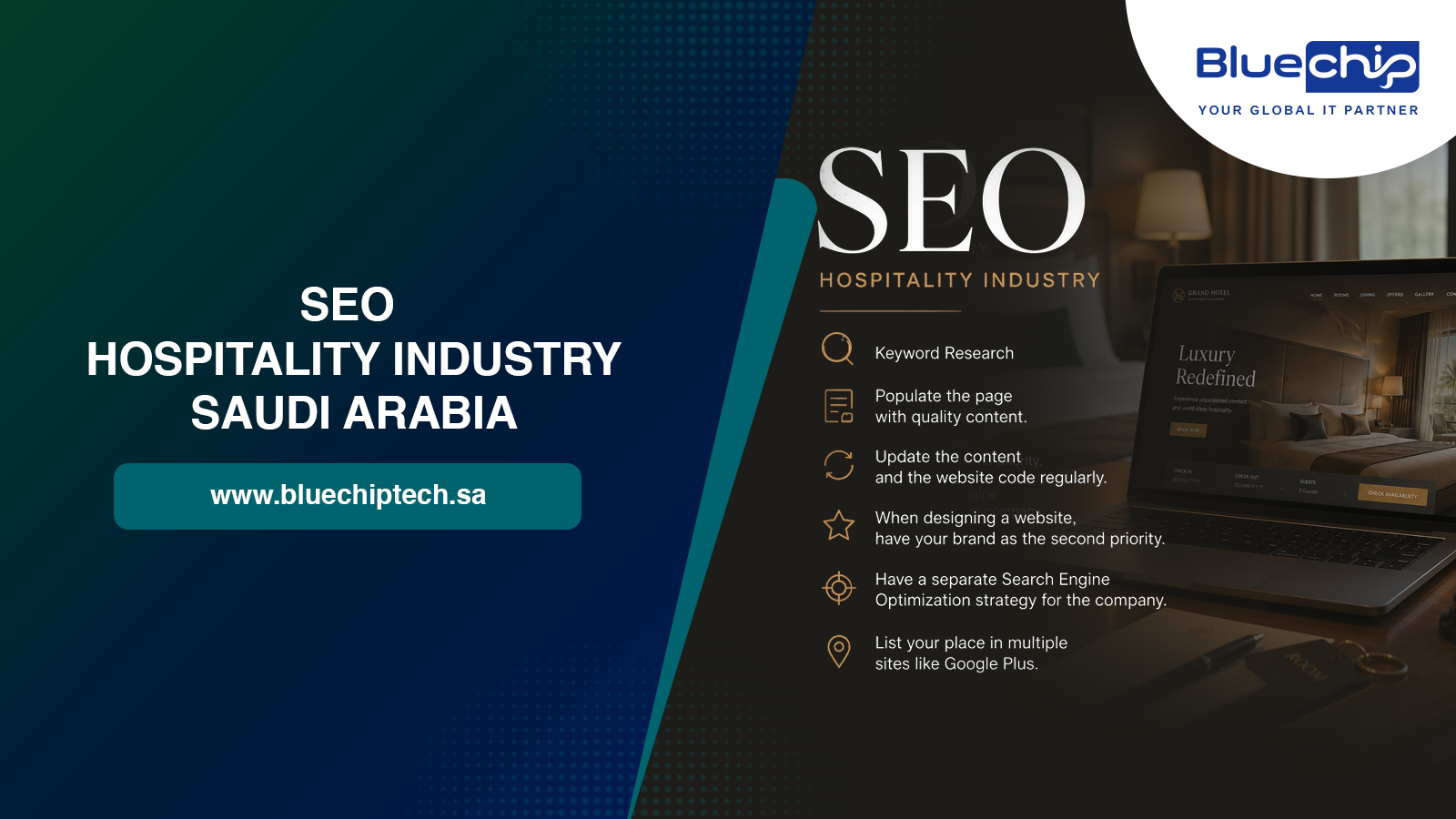
For hotels and hospitality businesses in Saudi Arabia, search visibility is closely tied to how clearly a website presents the property, location, rooms, amenities and booking path. A guest searching for accommodation in Riyadh may begin with a destination query, compare several properties, review room information and then move toward a reservation. Hospitality SEO helps connect those stages. Bluechip Advanced Technologies develops Saudi-focused SEO strategies designed to improve property discovery, strengthen Arabic and English visibility, support local search and make important hotel pages easier for search engines and potential guests to understand. The objective is not simply to attract more visits. It is to build relevant organic visibility around genuine property information and create a clearer route from search discovery to the hotel’s official booking experience.
SEO Built Around How Guests Search for Hotels
Hotel searches rarely follow one keyword pattern. A potential guest may search by destination, district, accommodation type, property name, room requirement, amenity or a combination of these. Some searches are exploratory; others show clear booking intent. Branded queries also behave differently from non-branded searches where the traveller has not selected a property.
An effective hospitality SEO structure maps these intentions to the most relevant pages. A Riyadh destination query may be supported by useful location content, while a room-specific search should lead to accurate room information rather than a generic homepage. Arabic and English queries also require separate research because terminology and phrasing can differ. This intent-led approach reduces unnecessary keyword overlap and gives each important page a defined role in organic search.
Hotel Property, Room and Amenity Page SEO
A hotel property page should clearly identify the property, genuine location, accommodation offering, relevant amenities, room links, imagery, contact details and booking route. Unique titles, headings, descriptive copy and internal links help search engines and guests understand the page.
For multi-property groups, each genuine property should have distinctive information rather than a template with only the location changed. Room, suite and amenity pages can target more specific intent when they contain verified features, useful images and a clear booking path.
SEO should not create thin pages for every minor keyword variation. Page creation should follow real guest needs and verified hotel information, with no invented room sizes, facilities, prices or availability.
Destination and Riyadh Search Strategy
A Riyadh property can strengthen destination relevance by explaining its genuine location and useful local context. Nearby districts, transport points or landmarks should only be referenced when factually relevant.
Destination content should help travellers make practical decisions and link naturally to property, room and booking pages. Avoid keyword-stuffed city pages, misleading ‘near’ pages and overlapping location pages.
SEO for Direct-Booking Intent
Organic visibility has greater commercial value when a guest can move smoothly from search results to the hotel’s official booking experience. Strong property pages, clear room information, visible booking calls to action and a mobile-friendly booking path all support that journey.
Broken booking links, inconsistent website and booking-engine information, slow transitions or poor mobile usability can interrupt high-intent visits. Separate booking domains or subdomains also need review. SEO cannot guarantee reservations, but it can create a clearer organic path toward the hotel’s own booking channel.
Arabic and English Hospitality SEO
Arabic and English hotel SEO should use separate keyword and intent research, including destination, property, room and amenity terminology. Professional localization and human review are preferable to literal translation.
Separate language URLs, correct hreflang, canonicals, language-specific metadata and consistent internal linking help search engines interpret both versions. Arabic pages also need RTL usability and booking-flow testing. Both languages should provide comparable content quality.
Local SEO, Google Maps and Hotel Reviews in Riyadh
A genuine Riyadh property should maintain an accurate Google Business Profile with the correct name, address, phone, website, category and imagery. Consistency across the website, Maps and relevant citations supports clear local discovery.
Hotels should monitor genuine reviews, respond professionally and use recurring feedback to identify information gaps. Fake or purchased reviews, artificial listings and doorway-style neighbourhood pages should never form part of the strategy.
Technical SEO and Hotel Website Performance
A technical audit should review sitemaps, robots directives, canonicals, redirects, broken URLs, duplicate or orphan pages and indexation. JavaScript-dependent content, parameter URLs and booking-engine architecture also require attention.
On mobile, large photography can hurt LCP, booking widgets and third-party scripts can affect INP, and unreserved image or widget space can cause CLS. Responsive images, compression, WebP/AVIF where suitable, caching, CDN use and script optimization can improve performance. Core Web Vitals do not guarantee rankings.
On-Page SEO and Hotel Structured Data
On-page SEO should align titles, descriptions, headings, URLs, property and room content, image alt text, breadcrumbs and internal links with guest intent. Booking calls to action should appear where they naturally support the next step.
Where appropriate, structured data may include Organization, Hotel or LodgingBusiness, HotelRoom or Accommodation, BreadcrumbList, ImageObject and accurate Offer data. Review markup should only be used when legitimately supported. Schema must match visible facts and never invent prices, availability, ratings or amenities.
Building Hospitality Authority and Measuring SEO Performance
Useful destination guidance, property information, amenity guides, business-travel resources and FAQs can support discovery and decision-making. Content should help guests plan or evaluate a stay, not exist only for keywords.
KPIs should go beyond traffic: priority and non-branded visibility, property/room-page performance, GBP interactions, Maps visibility, booking-engine clicks, booking starts, Search Console data, Arabic versus English performance, indexation and Core Web Vitals. Completed bookings or revenue should only be reported with reliable attribution.
Our Hospitality SEO Process
- Hotel website and current search visibility review
- Technical and booking-path SEO audit
- Saudi and Riyadh search-intent research
- Property, room and amenity keyword mapping
- Arabic and English planning where required
- Property, destination and on-page optimization
- Technical SEO and internal-linking improvements
- Local SEO, review and structured-data review
- Booking-path and organic performance monitoring
Why Work With Bluechip Advanced Technologies?
Bluechip Advanced Technologies can combine Saudi search-intent mapping, technical SEO, property-page optimization, bilingual planning, local search and booking-path improvement. The strategy should follow the hotel’s actual website structure and verified business information, with consistent property details, language versions and local signals.
Frequently Asked Questions
Hospitality SEO can include intent research, property and room-page optimization, destination content, technical and image SEO, local visibility, bilingual planning, structured data and booking-path analysis. Scope should reflect the hotel’s real properties and booking setup.
SEO can improve discovery for destination, property, room and amenity searches and connect users to the official website. Clear information, internal linking and an accessible booking path support higher-intent visits, but direct bookings cannot be guaranteed.
Property and room pages need a clear purpose, unique titles, accurate content, optimized images, internal links and an obvious booking route. Avoid duplicate property descriptions, and publish room details, amenities, prices or availability only when verified.
Riyadh visibility can be supported by accurate location content, a complete Google Business Profile, consistent business information, useful property pages, genuine reviews and relevant citations. Avoid artificial locations and repetitive doorway pages.
Arabic and English usually need separate keyword and intent research. Separate URLs, correct hreflang, language-specific metadata, human-reviewed localization and consistent internal linking help both versions work as one coherent site.
They support local property discovery. Accurate details, categories, photos, website links and genuine reviews make the listing more useful and should remain consistent with the hotel’s website and other authoritative references.
Relevant markup may include Organization, Hotel or LodgingBusiness, HotelRoom or Accommodation, BreadcrumbList, ImageObject and accurate Offer data. It must match visible information and never fabricate rates, availability, amenities or ratings.
There is no fixed timeline. Progress depends on technical condition, competition, content quality, authority, local presence and implementation speed. Indexation and impressions may move earlier, while sustained non-branded visibility and booking-related actions require ongoing measurement.
Improve Your Hospitality Search Visibility in Saudi Arabia
For hotels seeking stronger Riyadh and Saudi visibility, property discovery, room and amenity pages, bilingual search, local signals, technical performance and the booking journey need to work together. Bluechip Advanced Technologies can review these areas against the site’s actual properties and commercial priorities. Request a Saudi SEO strategy consultation to identify practical opportunities for improving hospitality search visibility and the organic path toward relevant booking actions.


