



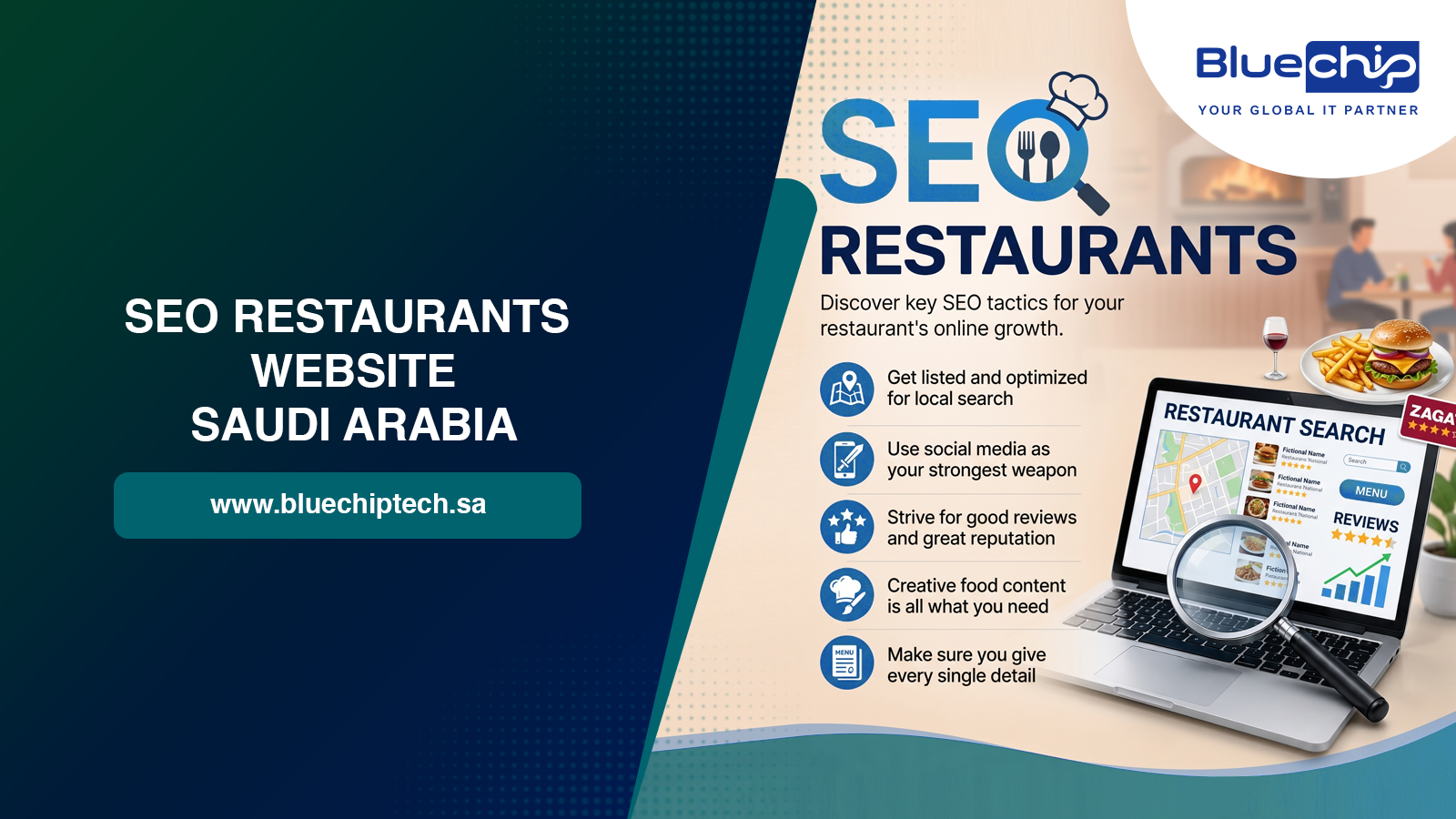
Restaurant discovery often begins with Google Search, Maps, or a menu check on mobile. For restaurants in Riyadh and across Saudi Arabia, visibility should help customers find accurate locations, menus, hours, reviews, directions and reservation options. Bluechip Advanced Technologies provides restaurant SEO services focused on local search, Google Business Profile, bilingual visibility and technical website quality, connecting relevant discovery with useful customer actions.
Restaurant SEO Built Around Saudi Search Behaviour
Restaurant searches are often immediate and specific: cuisine, dish type, neighbourhood, opening hours, brand, dining occasion or proximity. In Riyadh, restaurants may also need visibility across Arabic and English searches using different location and cuisine terminology.
Search intent matters more than traffic volume alone. A user checking a menu, directions, reviews or a Riyadh location is closer to a decision. Priority pages and local profiles should support these journeys.
Google Business Profile and Google Maps Visibility
For a restaurant, Google Business Profile is a core local-search asset. Customers may interact with the profile without visiting the website first, which makes accuracy essential. The restaurant name, category, address, telephone number, opening hours, website link, photos, menu information, and reservation or ordering links where applicable should reflect the real business.
Duplicate or outdated listings should be corrected, and profile details should agree with the official website. Wrong hours or an old phone number can interrupt a customer journey at the point of decision.
For restaurant groups, each genuine branch needs accurate information and a location page. Google Maps visibility is not guaranteed by adding keywords to a profile; relevance, business information, website signals and prominence all contribute.
Cuisine, Menu and Location SEO
Make Menus Easier to Discover and Use
Menus contain commercially important information. If a menu exists only as an image or PDF, mobile usability and search discoverability may be weaker than with accessible HTML content. PDFs can remain useful, but key menu information can also be presented on web pages where appropriate.
Menu optimization can use descriptive titles, headings, categories, internal links and accurate cuisine context. Pages should reflect what the restaurant genuinely offers rather than target every possible keyword.
Build Useful Restaurant Location Pages
Multi-location restaurants benefit from dedicated pages for real branches. Useful pages can provide the address, phone, hours, directions, relevant menu information, reservation links and local context. Thin pages that simply swap location names add little value and can create duplication.
Arabic and English Restaurant SEO
Bilingual sites also need sound implementation: separate language URLs, appropriate hreflang, consistent canonicals, language-specific metadata, links between equivalent pages and usable RTL layouts. Machine translation should not replace professional localization and human review.
Local Citations and Restaurant Information Consistency
Citation work should prioritize relevant platforms over mass directory submissions. When branch details change, the website and important external listings should be updated together.
Restaurant Reviews and Local Reputation
Reviews should remain authentic. Fake or manipulated reviews create risk, and no particular rating or review count should be treated as a guaranteed ranking formula.
Technical SEO for Restaurant Websites
Technical issues can undermine local visibility. XML sitemaps should surface priority pages, robots directives should not block them, canonicals should identify preferred URLs, and redirects should lead to relevant destinations. Broken pages, duplicate URLs, orphaned locations and outdated branch content also need review.
Mobile Performance and Core Web Vitals
Core Web Vitals provide useful performance signals: Largest Contentful Paint (LCP) covers main-content loading, Interaction to Next Paint (INP) responsiveness, and Cumulative Layout Shift (CLS) unexpected movement. Image optimization, caching, script control, font improvements and server performance may help where diagnostics justify them. These metrics are not a ranking guarantee.
On-Page SEO for Restaurant Pages
On-page work can include useful titles and descriptions, a clear H1, logical headings, descriptive URLs, image alt text, internal links, local relevance and obvious next actions. Each page should have a distinct search purpose to reduce cannibalization.
Restaurant Schema and Structured Data
Review or aggregate-rating markup should only be used when legitimately supported and eligible. Schema should be validated for errors and must match visible facts; it does not guarantee rich results or rankings.
Measuring Restaurant SEO Performance
Traffic alone does not show whether restaurant SEO is supporting business goals. Measurement should connect search visibility with the actions customers actually take. Depending on available analytics and platform reporting, useful KPIs can include:
- Organic visibility for priority cuisine and location searches
- Riyadh and branch-level local visibility
- Google Business Profile interactions and website clicks
- Calls, direction requests and reservation actions where measurable
- Menu and location-page organic performance
- Arabic versus English search performance
- Search Console impressions and clicks for priority queries
- Indexation of important pages and Core Web Vitals
Where reservation or ordering platforms permit reliable tracking, relevant conversions can also be measured. KPIs should reflect the restaurant’s real customer journey rather than arbitrary benchmarks.
Our Restaurant SEO Process
A restaurant SEO engagement can combine local, technical and content work in a structured sequence:
- Review the restaurant website and visibility.
- Audit technical SEO, crawlability and indexation.
- Research Saudi and Riyadh customer search intent.
- Map cuisine, menu and location keywords to appropriate pages.
- Plan Arabic and English optimization where required.
- Review Google Business Profile information and branch consistency.
- Improve priority website pages and internal linking.
- Review citations, local information and reputation workflows.
- Validate structured data and other local SEO signals.
- Monitor search visibility, local interactions and relevant conversions.
Why Work With Bluechip Advanced Technologies?
Restaurant SEO connects local search, technical SEO, content and bilingual website structure. Bluechip Advanced Technologies can align these areas with Riyadh intent, Google Business Profile, Arabic and English page planning, location architecture and measurable search actions without unsupported ranking or revenue promises.
Frequently Asked Questions
What does restaurant SEO include?
Restaurant SEO can include local keyword research, Google Business Profile optimization, Google Maps support, menu and location-page optimization, technical SEO, internal linking, structured data, citation consistency, review monitoring and mobile performance. The exact priorities depend on the restaurant’s website, number of locations, languages, search visibility and customer journey.
How can restaurant SEO improve Google Maps visibility?
Local SEO can strengthen the signals that help Google understand a restaurant’s identity, location and relevance. Work may include accurate Business Profile information, appropriate categories, consistent website and citation data, strong location pages and genuine review activity. No individual optimization guarantees a Maps position, so progress should be assessed across multiple local-search signals.
How should restaurants optimize Google Business Profile?
Start with accurate business information: name, category, address, telephone number, hours, website, photos and applicable menu or reservation links. Information should match the restaurant’s website and actual operations. Duplicate listings and outdated branch details should also be reviewed. Ongoing profile maintenance is important when hours, contact details or services change.
Do Saudi restaurants need separate Arabic and English SEO strategies?
Often, yes. Arabic and English customers can use different cuisine, dish and location terminology, so keyword research and content planning should account for each language. Bilingual sites also need correct technical relationships between language versions, including hreflang where appropriate, language-specific metadata, internal links and human-reviewed localization.
How should restaurant menu pages be optimized for Google?
Menu pages should be accessible, useful and structured around the restaurant’s real offering. HTML menu information can provide clearer context than relying exclusively on images or PDFs. Descriptive headings, logical categories, internal links and good mobile usability help both visitors and search engines. Menu details should remain accurate and should not be expanded simply to target unrelated keywords.
How does local SEO help multi-location restaurants?
Multi-location SEO helps distinguish genuine branches while maintaining consistent brand information. Each branch can have accurate Google Business Profile data and a useful website location page with its address, hours, contact details, directions and relevant local information. This structure also reduces dependence on duplicated pages that provide little value to customers.
Do customer reviews affect restaurant search visibility?
Reviews contribute to a restaurant’s online reputation and can influence customer decisions. Search platforms also use a range of local signals when presenting businesses. Restaurants should focus on genuine feedback, professional responses and policy-compliant review practices rather than trying to reach an artificial review count or using manipulated reviews.
How long does restaurant SEO take to show measurable results?
There is no fixed timeline because results depend on the restaurant’s starting visibility, competition, website condition, local presence, number of locations and the changes required. Technical fixes may be implemented quickly, while meaningful organic and local-search improvements typically require ongoing crawling, indexing, content refinement, profile maintenance and performance monitoring.
Improve Your Restaurant's Search Visibility in Saudi Arabia
For hotels seeking stronger Riyadh and Saudi visibility, property discovery, room and amenity pages, bilingual search, local signals, technical performance and the booking journey need to work together. Bluechip Advanced Technologies can review these areas against the site’s actual properties and commercial priorities. Request a Saudi SEO strategy consultation to identify practical opportunities for improving hospitality search visibility and the organic path toward relevant booking actions.


