



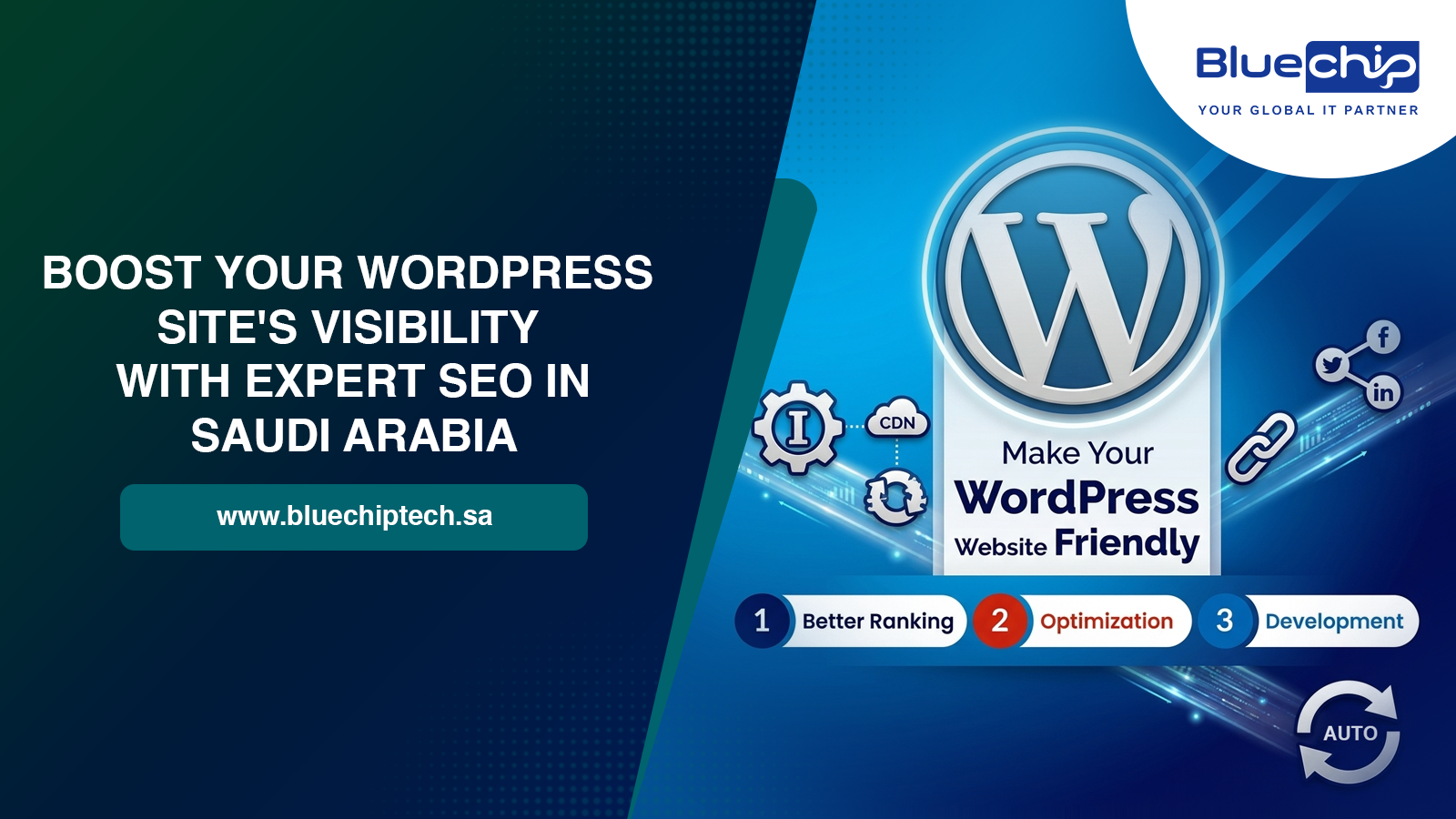
A WordPress website can look polished and still struggle in search because of technical settings hidden behind the theme, plugins, templates and indexation controls. For Saudi businesses, the challenge is often broader: the site must support commercial searches in English and Arabic, perform well on mobile, make important service pages easy for Google to crawl, and turn relevant visibility into enquiries. Bluechip Advanced Technologies provides WordPress SEO services in Saudi Arabia for organizations that need more than metadata updates. Our approach examines how WordPress is configured, how pages are discovered and indexed, how the site performs for users, and whether its content matches the way prospects search in Riyadh and across the Kingdom.
WordPress SEO Built Around Saudi Search Behaviour
SEO for a Saudi WordPress website should begin with the market and the customer journey, not a generic keyword list. A procurement manager searching in English may describe a service differently from an Arabic-speaking decision-maker. A company targeting Riyadh may also need location relevance without turning every page into repetitive city-focused copy. The objective is to connect the right service pages with meaningful commercial searches and make those pages credible enough to support an enquiry.
Why WordPress Websites Lose Search Visibility
WordPress is flexible, but that flexibility can create SEO problems when themes, plugins and publishing settings overlap. A website may generate category, tag, author, search and attachment URLs that add little search value. An SEO plugin can output one canonical while a theme or another plugin adds conflicting schema or metadata. Old URLs can remain in Google after a redesign, while new service pages receive too few internal links to be treated as important.
These issues are not cosmetic. Incorrect canonicals can encourage search engines to consolidate signals to the wrong URL. Redirect chains waste time for users and crawlers. An accidental noindex directive can remove a revenue-critical page from search. Weak archive controls can spread crawl attention across low-value URLs, while broken internal links make it harder for both users and Google to reach key services.
Technical WordPress SEO for Saudi Businesses
Crawlability and indexation
A technical WordPress SEO audit should establish which URLs are meant to appear in search and whether the website is communicating that consistently. We review XML sitemaps, robots.txt, meta robots directives, canonical tags, redirects and status codes. Category and tag archives, author pages, internal search results, media attachment pages and pagination are assessed according to their actual purpose rather than automatically indexed or blocked.
Staging and migration settings deserve particular attention. WordPress includes a search-engine visibility setting that can lead to serious problems when it remains enabled after launch. Conversely, an unprotected staging site can become crawlable and create duplicate versions of production content. HTTP/HTTPS and www/non-www variations should also resolve consistently so the preferred site version is clear.
Plugin and theme review
Installing more plugins is not an SEO strategy. Multiple SEO plugins can produce competing canonicals, sitemaps or schema. Performance plugins may duplicate minification or caching functions. Page builders can add substantial markup, CSS and JavaScript that affect speed and interaction. A useful review identifies what each component is doing, where functions overlap and which changes can improve search performance without disrupting business-critical website features.
Core Web Vitals and WordPress Performance
Largest Contentful Paint (LCP) measures how quickly the main visible content is rendered. On WordPress, poor LCP can be linked to large hero images, slow server response, render-blocking stylesheets, heavy themes or weak caching. Interaction to Next Paint (INP) evaluates responsiveness after a user interacts with the page; excessive JavaScript, complex page builders, plugins and third-party scripts can contribute to delays. Cumulative Layout Shift (CLS) measures unexpected movement, often caused by images without dimensions, late-loading fonts, cookie banners, widgets or dynamically inserted elements.
Optimization may involve compressing and appropriately sizing images, using modern formats such as WebP or AVIF where suitable, improving caching, reviewing CDN use, reducing unnecessary scripts, optimizing CSS and fonts, auditing plugins and assessing hosting or server response. The goal is a faster, more stable website for users. Passing Core Web Vitals is not a guarantee of higher rankings; it is one component of a broader technical, content and authority strategy.
Arabic and English WordPress SEO in Saudi Arabia
Bilingual WordPress SEO requires more than translating an English page and publishing the Arabic version. Search behaviour, terminology and commercial intent can differ between languages, so keyword research and content planning should be carried out separately. Professional localization and human review are particularly important for technical or B2B terminology, where a literal translation may be understandable but not reflect how a Saudi prospect naturally searches or evaluates a service.
The website architecture must support that strategy. Separate language URLs should be connected correctly with hreflang where appropriate, while canonical tags should avoid accidentally pointing one language version to another. Metadata should be written for each audience, navigation and page layouts should work naturally in right-to-left Arabic, and important internal links should help visitors move between relevant language versions. Both versions should offer comparable value; thin translations or mixed-language duplicate pages can weaken the overall experience.
On-Page WordPress SEO That Supports Commercial Intent
On-page optimization starts with matching each page to a clear search purpose. A service page should have a focused title, useful meta description, logical H1-H3 hierarchy, readable URL and enough information for a buyer to understand the problem, approach and next step. Internal links should connect related services and supporting resources rather than repeatedly using exact-match anchor text.
Images need meaningful alt attributes when they convey information, breadcrumbs should reflect a logical site structure, and calls to action should appear where they help a visitor progress. For a WordPress SEO company in Saudi Arabia, the objective is not to reach an arbitrary keyword density. It is to make the page clear to search engines while giving a Saudi business decision-maker enough relevant information to consider contacting the company.
WordPress Local SEO for Riyadh
Companies serving Riyadh can strengthen local relevance through accurate business information, a properly maintained Google Business Profile, useful Riyadh-focused service content and consistent internal linking. Where dedicated location pages are justified, they should contain genuinely distinct information about the service and audience rather than a city name swapped into the same template. Reviews and reputation signals can also help prospective customers evaluate a business, while Google Maps visibility should be supported by accurate location and business data.
Our WordPress SEO Process
- Website and business discovery
- Technical WordPress SEO audit
- Keyword and search-intent research
- Arabic and English planning where required
- Technical fixes and on-page optimization
- Internal linking and structured data review
- Core Web Vitals and performance review
Frequently Asked Questions
What does WordPress SEO include?
WordPress SEO can include technical auditing, crawl and indexation controls, keyword and intent mapping, on-page optimization, internal linking, performance review, structured data, sitemap and canonical configuration, content improvement and monitoring. The exact scope should depend on the website rather than applying the same checklist to every installation.
How is WordPress SEO different from general SEO?
The principles of SEO are platform-independent, but WordPress has platform-specific issues involving plugins, themes, page builders, archives, media URLs, sitemaps and SEO settings. Effective optimization requires understanding how those components generate pages, metadata, schema and performance overhead.
Do Saudi businesses need separate Arabic and English SEO strategies?
Often, yes. Arabic and English audiences may use different terminology and express commercial intent differently. Separate keyword research, localized content, language-specific metadata and technically correct language targeting can produce a better experience than directly translating an English keyword plan.
Can WordPress plugins cause SEO problems?
Yes. Plugins can create duplicate functionality, conflicting metadata or schema, unnecessary URLs, redirect issues and performance overhead. The solution is not automatically to remove plugins; it is to understand their purpose, configuration and interaction with the theme and other components.
How do Core Web Vitals affect a WordPress website?
Core Web Vitals measure important aspects of loading, responsiveness and visual stability. Poor performance can frustrate users and indicate technical inefficiencies. Improvements should focus on real user experience alongside broader SEO factors rather than treating a passing score as a ranking guarantee.
Do Saudi photographers need separate Arabic and English SEO strategies?
Separate planning is useful when targeting both audiences because search terminology and intent can differ. Keyword research, metadata and localization should be handled independently, while separate language URLs, hreflang and internal linking need correct technical implementation. Arabic content should receive human review.
Can large image galleries slow down a photography website?
Yes. Large files, excessive images, sliders, lightboxes and JavaScript can increase loading and interaction costs. Responsive delivery, correct dimensions, compression, caching, careful lazy loading and script optimization can reduce unnecessary weight while preserving portfolio quality and image accessibility.
How long does photography SEO take to show measurable results?
There is no fixed timeline. Technical condition, competition and content quality can affect progress. Measurement should begin early using visibility, indexing, Search Console data and lead actions, while recognizing that organic improvement usually requires ongoing optimization.
Improve Your WordPress Visibility in Saudi Arabia
If your WordPress website is technically difficult to crawl, slow on mobile, poorly aligned with Saudi search intent or not generating visibility for important services, a structured review can identify where the problems begin. Request a Saudi SEO strategy consultation with Bluechip Advanced Technologies to assess technical WordPress SEO, Core Web Vitals, Arabic and English search requirements, Riyadh visibility and the priorities that can support more relevant organic discovery.


